
The Most Impactful Feature of Salesforce’s Summer 20 Release
In FinServ’s opinion, the new Kanban Split View is the most exciting feature of the Salesforce Summer ’20 Release. In this article, we will highlight how Funds and Financial Services companies can take advantage of this new feature to realize maximum benefit and ROI. If you would like more insight into these updates and how to implement them, please feel free to contact us at info@finservconsulting.com or by completing our Salesforce inquiry form
Expedited Prospect Data Updates with the Kanban Split View
Sales and Marketing teams are constantly working through the list of their top prospects each day. They realize that updating Salesforce with the latest key info is critical to moving the pipeline forward.
The Kanban view was a huge step forward in previous Salesforce releases. By providing a visual pipeline with the ability to drag and drop items to the next stage, it made pipeline stage updates much more efficient.
Up to this point however, the process of editing these records was a tedious, click-heavy effort of having to go into each record, edit the record, save the record, refresh the screen, and move onto the next record to edit.
With the Salesforce Summer ’20 release, users now have the Split View for Standard Navigation feature. This exciting new feature allows the user to highlight the record they want to edit, right in the Kanban view, and edit the key fields all from the same screen!
Sales and Marketing teams will save hours of time with a level of efficiency previously unattainable in any CRM. By making it easier to update the record, it also promises to improve the quality of the data for the Executive and Investor Relations teams as well.
Split View for Standard Navigation in Kanban View

Key Considerations:
- You must have a Sales Path setup for the Object you want to use this for
- The Sales Path will ask you to select the Key Fields you want to be able to Inline Edit
a. The Key Fields can and should be different for each stage to ensure you are providing your team the quick edit access they require
b. The Key Fields are limited to just 5 per stage, so pick carefully - Provide Guidance in each Stage to ensure your team fully understands what is expected to be filled in and you gain maximum value from the quality data
Salesforce Video on this Exciting New Feature
Conclusion
The Summer ’20 Release is schedule to arrive on July 18th. FinServ Consulting, a top Salesforce Partner with a focus on the Asset Management sector, ensures our clients take advantage of the most important features of each release and maximize their investment in Salesforce.
Over the next few weeks, we will continue to highlight the new features we see as most valuable to our clients, with a unique focus on our industry. Upcoming posts will include exciting new developments to Lightning Flow, which is fast becoming the most useful tool in the Salesforce arsenal for process automation.
If you are interested in any of these features and want help implementing them or just have a question about them, please contact us here or by email at info@finservconsulting.com and we would be happy to help.
About FinServ Consulting
FinServ Consulting is an independent experienced provider of business consulting, systems development, and integration services to alternative asset managers, global banks and their service providers. Founded in 2005, FinServ delivers customized world-class business and IT consulting services for the front, middle and back office, providing managers with optimal and first-class operating environments to support all investment styles and future asset growth. The FinServ team brings a wealth of experience from working with the largest and most complex asset management firms and global banks in the world.

What You Need To Consider When Choosing A New OMS
Undergoing technological change or implementing a new system is not something to be taken lightly in ordinary market environments, much less during a time of extreme or abnormal market volatility. If your fund or organization is planning to implement a new OMS or replace a legacy OMS, there are several things you should consider.
From a business and investment standpoint, there are the usual key considerations, including: the need for integrated OMS/EMS functionality, whether ease of use important, ability to customize workflows and if there is a desire for extensive client/marketplace connectivity. From an operational perspective, one must also consider other non-functional items like data migration (and how easy it is to implement), the software support model, modularity and future expandability.
The aforementioned list only touches the surface; the overarching themes involve automation, workflows, analytics and decision-support tools. In fact, in a recent Refinitiv/Greenwich Associates paper, traders ranked an EMS as the most impactful technology in the short-term.
OMS vs EMS
In general, hedge funds treat the Portfolio Manager (PM) and Trader workflows as a single unit, whereas traditional asset managers may have additional bifurcation between roles and responsibilities. At a hedge fund where the PM sends orders via email/chat/voice to a trader to execute, they may want a single, integrated OEMS. On the other hand, an asset manager often has multiple PMs who route orders to a centralized trading desk. In this case, the institution may want a solution with specific standalone OMS and EMS functionality, in order to access best-of-breed functionality.
The trend in the marketplace for a while has been OMS vendors integrating additional trading functionality by buying or building EMS solutions. This results in the ability to capture and allocate client orders while also capturing execution details to help the firms comply with regulatory requirements. Additionally, this allows them to market themselves as an all-in-one solution and would insulate the client from having to integrate yet another vendor into their technology stack.

Source: Charles River Development
Ease of Use
Being able to get your operations, back office and front office users onboarded and using the software as quickly as possible can be a heady concern for most clients. In theory, this sounds simple, but many legacy OMS were designed with a single asset class in mind. If your client is now multi-asset, multi-strategy and trading a variety of instruments in volume, it’s even more imperative that a system be easy to use and operate as one cohesive platform.
A modern interface with intuitive workflows can be a competitive advantage especially if the fund’s current OMS platform is antiquated and requires, in a worst case scenario, dual entry or swivel-chairing in order to execute and fill an order. (Swivel chairing involves a PM creating orders/allocations in an OMS and then sending them over to trader for execution in an EMS).
Ease of Customization
A vendor’s product team always has to find the right balance of customization and the notion of a standard offering for the client. However, in this day and age where customizability is king, most vendors are client-driven and willing to bend over backwards for their clients. Enfusion Systems, whose product features weekly upgrades, has marketed their product as being easily customized. In a recent implementation with an asset manager, Enfusion agreed on development of specific functionalities within their platform that would position them well for the changing OEMS marketplace. The client agreed on an OMS implementation, while also using Enfusion’s Services team for reconciliations (the client still kept some functionality in-house, like collateral management).
Client/Marketplace Connectivity
Most multi-strategy funds that trade a wide breadth of products across different asset classes and venues will always be excited at the prospect of having a vendor whose product comes pre-packaged with existing API connectivity to brokers, venues and marketplaces. Many clients have a baseline expectation of connectivity with a full suite of partners across the spectrum of asset classes. If this is not currently in the vendor’s repertoire, the expectation is that connecting to new trading venues and brokers would be trivial.
Data Migration
One of the most underestimated Issues that can be the source of delays for most implementations is data migration. What seems like a simple exercise to port accounting/trading data from the client’s old system to the new system can lay bare a client’s unreconciled data and inconsistencies between trading data and official books and records. Having clean, reconciled source data from the client that can be matched to the client’s custodian or fund administrator sounds simple. In practice, many things can go wrong and be a source of delays. Finding a vendor who has experience successfully migrating trade data, for funds that are similar to their current structure, in a timely manner is the holy grail.
Our Implementation Project with Enfusion and an Asset Manager
FinServ is currently engaged with an institutional asset manager on the implementation of Enfusion’s comprehensive front-to-back trading software product. The asset manager is looking to implement a new front-to-back office system for one of their businesses. Because their current portfolio management system is a legacy product, the product features were outdated and users found the workflows to be inefficient. By implementing a new portfolio and order management system, they would be able to control service levels and more importantly, they would be able to custom develop functionality that match their growing business needs.
After an extensive vendor selection process, the asset manager chose Enfusion Systems. Enfusion was able to make their choice easy due to their cloud-based solution, which provides integrated order and execution management as well as middle office and IBOR services. Although not the focus of this article, the asset manager was also looking to outsource part of their back office to Enfusion’s Services team. Using one vendor for both OMS and back office was one of the key drivers behind their decision. In addition, having a single data model also provided a golden copy for data for all users across all functions. Since the asset manager’s business model involved trading a diverse set of product types and made use of heavy derivatives, Enfusion’s ability to handle multiple asset classes also made sense.


Considerations
Because implementing a new OMS was such a large effort, the timelines for launching and migrating an initial account and eventually the entire business spanned much longer than a year. A decision was made to have a phased approach, where specific sets of strategies and funds would be moved to the new platform in stages.
In order to alleviate some concern that the execution tools, order management workflows and trade compliance functionality would not be replicated completely (due to extensive in-house custom enhancements over the years), Enfusion worked closely with the client to address these items.
From the client’s standpoint, adding a new system would also add additional complexity – additional integration points, extra feeds into and out of their books and records system, the necessity to have Trading operate out of multiple platforms simultaneously, a bifurcation of the client’s Operations team to handle both sets of systems and lastly, having PMs manage portfolios and strategies across multiple systems during the phased implementation.
“Enfusion and FinServ worked side-by-side during this project – we ran implementations, gathered clients’ requirements and dived deep into the use cases. Both parties were truly collaborative and this enabled accountability with the client. FinServ has tremendous project management experience and it was great partnering with them.”
– Brad Flax, VP of Business Development at Enfusion
Summary
If you are interested in learning more about our current and past Enfusion implementations, please reach out to FinServ. Throughout our 15 years of existence, we have proven that our deep industry knowledge combined with our project management and overall best practice methodologies can be an asset to your organization. To further continue the conversation or to discuss more of FinServ’s capabilities, please contact FinServ at info@finservconsulting.com or give us a call at (646) 603-3799.
About FinServ Consulting
FinServ Consulting is an independent experienced provider of business consulting, systems development, and integration services to alternative asset managers, global banks and their service providers. Founded in 2005, FinServ delivers customized world-class business and IT consulting services for the front, middle and back office, providing managers with optimal and first-class operating environments to support all investment styles and future asset growth. The FinServ team brings a wealth of experience from working with the largest and most complex asset management firms and global banks in the world.
HCM for Asset Managers: Find the Right Solution for Your Firm
An HCM solution is an integrated system that automates HR functions combined with finance, planning, and analytics and allows for employee self-service capabilities, thereby reducing labor costs, optimizing business processes, and increasing efficiency. Companies that transition from manual processes and disparate legacy systems to modern, cohesive digital workforce management technologies can realize up to 15-25% cost savings related to HR and IT spend.
Most current HCM solutions are offered as a cloud-based, SaaS delivery model and include modules for payroll, HR, time and labor management, and recruitment. This type of solution does not require an expensive hardware investment and constantly updates software to the latest version while maintaining secure backups. These systems are monitored at all times and provide the utmost reliability. An added plus for asset managers is that the solutions can be customized to suit the size of any company and grow as the organization grows.
At FinServ Consulting, we have experience working with firms of various sizes in the alternative asset management industry to select, implement, and/or upgrade their HCM systems. While there are numerous benefits of having one comprehensive, integrated HCM, there are other options available on the market such as lite solutions that meet basic needs without all the added features that may not be necessary for some firms, as well as point solutions that cater to the industry’s unique needs, like complicated compensation structures. FinServ can help assess your company’s specific requirements to identify what to be aware of in terms of missing features, implementation issues, and cost-benefit analysis of different HCM options.
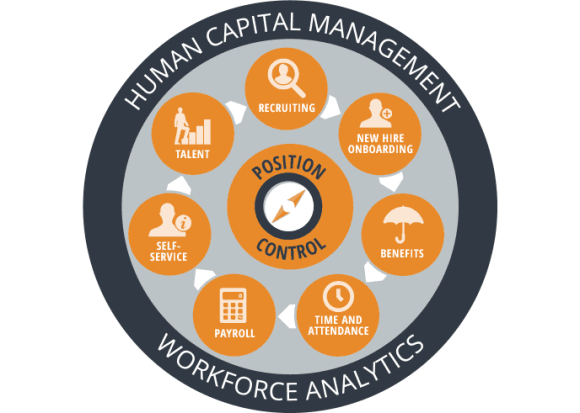
Benefits of a Consolidated HCM
Attract and Grow Talent
Recruiting top talent and keeping them engaged is no longer just HR’s responsibility—talent objectives can have a significant financial impact on growing a financial services business. Implementing a new HCM system can help enhance performance management processes to eliminate bureaucracy and encourage meaningful conversations between managers and employees focused on performance improvement. In addition, better compensation data and visibility of top talent allow managers to make more well-informed decisions regarding performance and rewards.
Some clients in the alternative asset management space that FinServ has previously worked with used manual spreadsheets to manage staff performance, as well as recruiting and other functions in some cases. However, by opting for a consolidated HCM system, these organizations were able to use more sophisticated workflows to provide employees with more meaningful feedback. Also, they could track and monitor operational outcomes and staff development across the company to ensure a payback from their HCM investment.
Make Better Informed Decisions
Asset management firms in the current environment face increasing regulatory scrutiny, such as GDPR, AIFMD, and Form PF, and constantly evolving standards. In order to meet the new generation of demands, these companies need to make well-informed investment decisions with visibility into all business lines. However, this is a difficult task when the data required to deliver these insights is housed in disparate legacy systems with varying formats and level of detail. This is where having consolidated HCM comes in—a single system for finance, HR, planning, and analytics can offer the necessary foundation to gain better insights, save time on data aggregation, and proactively solve business problems. A digital solution of this type can help improve business margins, provide competitive differentiation, attract and retain customers, and identify lucrative areas for growth.
Harness the Power of Modern Data
Today’s financial companies have an unprecedented amount of valuable data across their organization. However, many are still not able to access this data due to isolated, unorganized, and inaccurate legacy systems. The data warehouses that are typically accessed by business intelligence tools to create reports or perform financial analyses hold data that was accurate at the time it was loaded and refreshed from legacy systems, resulting in a high likelihood that it is out-of-date and unreliable. As a result, financial services firms often turn to add-on custom software solutions to try and achieve real-time data extraction, but these products often produce further challenges because they require continuous maintenance to keep up with the changing needs of the business.
Implementing a contemporary, consolidated HCM system allows firms nimble access to the real-time data that is necessary for constantly changing business needs. These solutions include technologies, such as cloud computing, open APIs, artificial intelligence, and machine learning, that make insights transparent and accessible across lines of business.
Build Organizational Agility
Being agile is key to an asset manager’s long-term success and there are several factors at play in building organizational agility:
- Adaptable: A flexible technology foundation is essential to be able to change organizational structures and processes in response to regularly shifting business needs.
- Skilled: Financial services firms, among others, face a widening skill gap and must find ways to upskill their workforce.
- Empowered: In order to perform at the highest potential to meet evolving consumer expectations and drive success, employees need full access to data to make business decisions.
- In Control: The need for measurement and control goes hand in hand with agility and speed. Asset managers must measure more relevant KPIs to learn from what works and what doesn’t when it comes to new digital revenue streams.
There are common obstacles that firms must overcome to meet the guidelines above, including inflexible legacy technologies, bureaucratic organizational culture, and a lack of relevant employee skills. By using a comprehensive HCM solution to add intelligence to business tasks, financial firms can move past these challenges and employ integrated, real-time planning in order to build organizational agility and realize their digital growth aspirations.
Choose the Right Solution
As mentioned previously, there are many HCM offerings available on the market and it is important to select the right one to meet your firm’s unique needs. There are several factors to consider, such as the needs and priorities of the business, size of the firm, and desired metrics and reporting abilities. FinServ Consulting has experience working with asset management firms to identify and implement a suitable HCM solution. We can help you make the right decision and take full advantage of the capabilities and rewards that the new solution will provide.
Summary
If you are interested in establishing or improving your firm’s HCM platform, FinServ Consulting is the right partner to help you reach your firm’s strategic objectives. Throughout our 15 years of existence, we have proven that our deep industry knowledge combined with our project management and overall best practice methodologies can be an asset to your organization. To further continue the conversation or to discuss more of FinServ’s capabilities, please contact us at info@finservconsulting.com or give us a call at (646) 603-3799.
About FinServ Consulting
FinServ Consulting is an independent experienced provider of business consulting, systems development, and integration services to alternative asset managers, global banks and their service providers. Founded in 2005, FinServ delivers customized world-class business and IT consulting services for the front, middle and back office, providing managers with optimal and first-class operating environments to support all investment styles and future asset growth. The FinServ team brings a wealth of experience from working with the largest and most complex asset management firms and global banks in the world.
Sowing a Field to Cultivate: Driving Sales via Contact-Based Leads in Salesforce
One of the recurring challenges new Salesforce clients encounter during their implementations is grappling with how standard Salesforce objects/functions align with their actual business processes. It is one side of the knowledge sharing gap on any new vendor software implementation. The other side of the gap is that technology teams need to get up-to-speed on a client’s business as quickly as possible. This includes a macro understanding of the client’s industry, the specific business processes related to the project, and how any legacy systems work to support client activities today. The faster these gaps close, the better the final solution will be in the end.

The goal of this article is to address the client-side knowledge gap by educating potential Salesforce clients about one of the critical design discussions in any Salesforce implementation: When Should Contacts be Created in Salesforce? To answer that question, the article will provide a quick overview of some core Salesforce basics, along with FinServ’s rationale supporting Contact-Based Leads for Financial Services clients:
- What is the Difference Between a Lead and an Opportunity in Salesforce?
- What are Salesforce Contacts? When are Contacts Created in the Default Salesforce Workflow?
- What is a Contact-Based Lead Approach? Why is it a Better Choice?
Leads Convert into Opportunities

What is the Difference Between a Lead and an Opportunity in Salesforce?
In Salesforce, Leads represent potential deals that have not been fully vetted or “qualified”; they could also be referred to as “unqualified opportunities”. In this case, qualified refers to confirmed interest from a prospect to buy a specific product/service/offering. Leads can come from a variety of sources, such as real-life interactions like meeting someone at an event or when someone fills out a form on a website requesting more information on a specific product/service.
What separates Leads and Opportunities is how realistic the deal is based on confirmed client interest. Opportunities are real, active deals with confirmed, measurable interest from a prospect. When that hurdle is met, Leads are considered qualified and they are “converted” into Salesforce Opportunities. Opportunities are the sales and pending deals that need to be tracked. By creating Opportunities, a “pipeline” of deals is formed, which may be tied to sales forecasting and advanced pipeline reports.

What are Salesforce Contacts? When are Contacts Created in the Default Salesforce Workflow?
Contacts are the golden source of all data related to a person/individual. The set of Contacts in Salesforce is simply a modern-day rolodex. Out-of-the-box Salesforce includes basic datapoints for Contacts one would expect like phone numbers, email addresses, and mailing addresses. When you convert a Lead in Salesforce, the system guides you through the creation of new Accounts, Contacts, and Opportunities, while connecting that data with the information already on the platform.
This default Lead-to-Contact process flow makes sense for a lot of Salesforce clients that are dealing with a high volume of low-quality Leads. An example of this would be a web-based retail store; lots of potential customers might show up through various channel source that need to be filtered and cultivated. Keeping your Leads and Contacts separate help to reduce tracking bad person/individual data from Leads in Salesforce Contacts. The problem with this approach is that Leads are never associated with a Contact until the Lead is qualified and the actual Lead conversion process occurs, which means you lose prospect history. This affects a couple key areas for most of FinServ’s financial services clients:
- Cross-Selling New Products/Services to Existing Clients: Valuable historical information from past interactions on a Contact are never associated with new Leads for the same person/individual. That includes the basics like simple contact information to important details like preferred market strategies and potential commitment amounts for a hedge fund client.
- Re-engaging Old Leads: Even if Leads don’t convert in an isolated sales cycle, most FinServ clients are not dealing with high volume, low-quality. The Leads available are usually curated through existing relationships or through industry service like capital introduction. It is important to curate all this information whenever new Leads are created to avoid face losing valuable details.
What is a Contact-Based Lead Approach? Why is it a Better Choice?
The simple solution to all these issues with vanilla Salesforce is simply to adopt a Contact-Based Lead Approach. This means that users may create Leads from existing Contacts and relate Lead records to Contacts before the Lead conversion process occurs. It’s that easy and it facilitates the ability to handle the above limitations with standard Salesforce, while also supporting common business activities like the ability to track multiple Leads for the same Contact.
The Bottom Line
Adopting Contact-Based Leads is quick solution to solve some of the major limitations of vanilla Salesforce to align the platform with financial services businesses; however, it is a major design decision that is easier to enforce for new implementations. It is always better to measure twice and cut once. FinServ Consulting’s industry expertise and unparalleled track record for financial services clients makes us the right partner to help you make the best decisions to support your business.
To learn more about FinServ Consulting’s services, please contact us at info@finservconsulting.com or (646) 603-3799.
About FinServ Consulting
FinServ Consulting is an independent experienced provider of business consulting, systems development, and integration services to alternative asset managers, global banks and their service providers. Founded in 2005, FinServ delivers customized world-class business and IT consulting services for the front, middle and back office, providing managers with optimal and first-class operating environments to support all investment styles and future asset growth. The FinServ team brings a wealth of experience from working with the largest and most complex asset management firms and global banks in the world.
Cybersecurity Protection with Salesforce Shield
Salesforce recently introduced a cybersecurity focused offering that builds on the already formidable security capabilities of the world’s leading customer relationship management platform. With Salesforce Shield, organizations can institute better internal cybersecurity practices by developing clearer oversight of employee’s daily activities and stronger protection of their valuable data. Salesforce Shield expands on the class leading security infrastructure of Salesforce across the three key service areas of:
- Platform Encryption
- Event Monitoring
- Field Auditing
Salesforce Shields’s focus on these three services allows for a more nuanced utilization of privacy functionalities and clearer oversight into the firm’s cyber activities. Of course, administrators of standard Salesforce environments could always customize their firm wide security settings through a variety of restrictions, permissions, and requirements across the platform. However, with Salesforce Shield, administrators have exponentially deeper control and granularity when establishing and maintaining their firm’s online security. This article will provide an overview of each Salesforce Shield’s services, as well as the key factors management should consider when implementing the technology.

Platform Encryption
A standard Salesforce subscription only allows for the encryption of custom fields that are less than 175 characters, which is likely insufficient for many firms that maintain large amounts of customer data. For the first time, Salesforce Shield brings encryption to a wider range of custom and standard fields, including sensitive information such as Account Names, Addresses, Phone Numbers, and Emails. Platform Encryption with Shield allows users to natively encrypt their most sensitive data such as personally identifiable information (PII), confidential, or proprietary data, while meeting internal and external compliance regulations. Salesforce Shield also allows users to adopt the latest encryption innovations, such as Bring Your Own Keys (BYOK), which allow users to provide their own tenant secret, generate their own Hardware Security Module (HSM), and ultimately increase their control over the encryption processes.

Implementation Considerations:
1) Identify Encryption Needs
-
- Firms need to first identify their unique encryption needs. Encrypting every piece of data that a firm has online would slowdown workflows, leading to inefficiencies that provide little returned value. Firms should identify and evaluate the potential channels and methods of attack they face, while also classify the data types that they would like to protect. At the same time, firms can specify which fields are the truly “must encrypt” elements and evaluate the business functionality changes that may come with encrypting this information.
2) Apply Field Level Encryption
-
- Because encryption can be assigned at the field level across different users, firms need to decide which fields would be accessible by different users. Shield allows firms to grant permissions to certain fields only for authorized users, while also applying encryption to these fields for an added level of security. Once these capabilities have been properly vetted, users can begin testing how their business processes would work with this newly encrypted data.
3) Define Key Management Strategy
-
- Shield enables firms to take on greater ownership over their encryption key management strategy. For an effective implementation of Salesforce Shield, firms should identify who can manage the encryption keys and define the protocols for backing up, rotating, and archiving keys.
4) Maintain Organization’s Encryption Policy
-
- Platform encryption requires strong policy and procedure documentation to guarantee its effectiveness. Establishing the lifecycle of keys and periodic data backups ensures that the data your firm has today is securely maintained in the future as well. Meanwhile, periodic reviews of encryption protocols ensure that these established policies remain effective as data grows and new fields are added. Regular reviews of data encryption protocols are a critical aspect of continued data security and data effectiveness with Salesforce Shield.
Event Monitoring
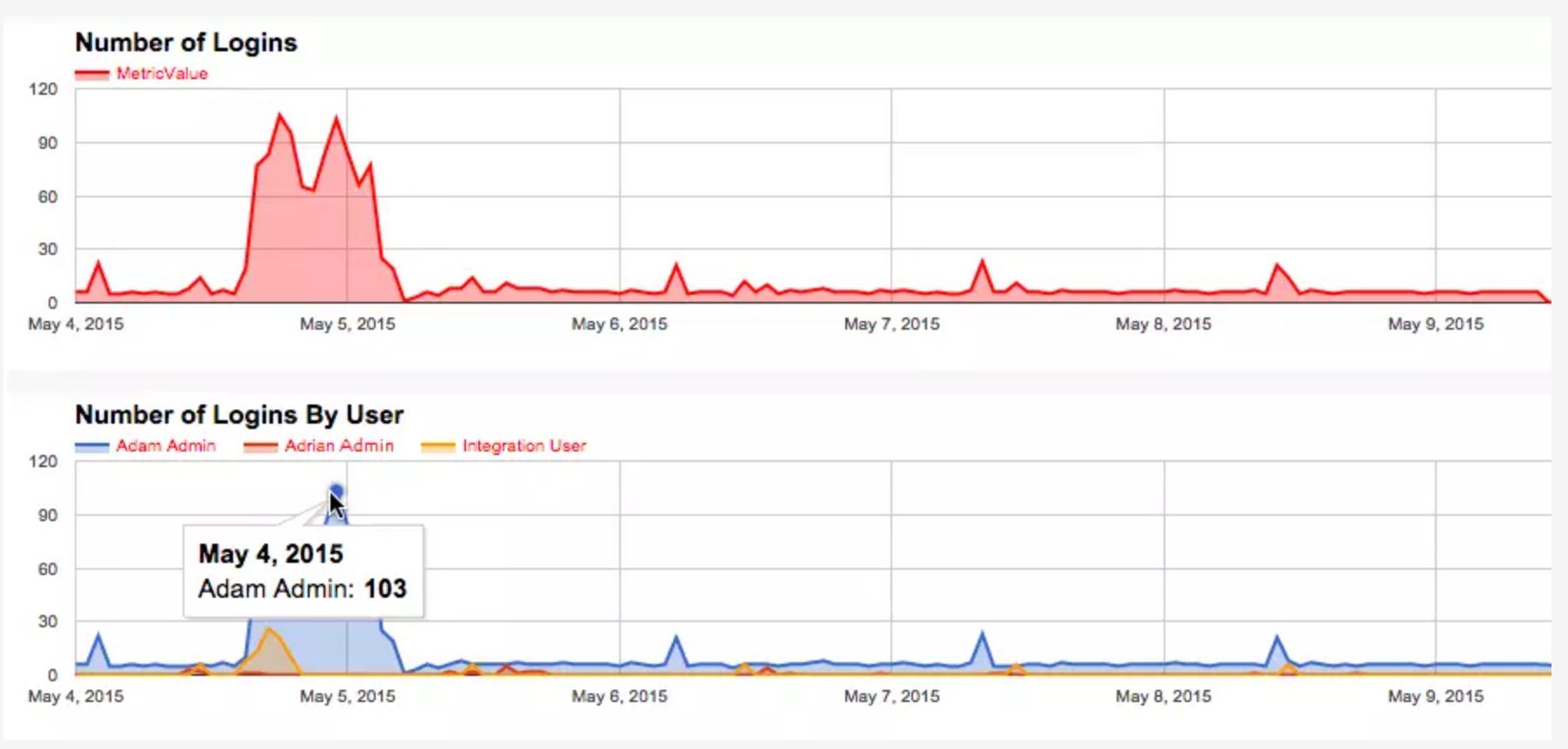
Salesforce Shield allows firms to have even clearer oversight of critical business performance and user behavior data. Firms using Salesforce Shield have a deeper understanding of the underlying performance, security, and individual usage of data stored in their Salesforce ecosystem. With Event Monitoring, managers can drill deeper into their event log files in order to visualize time relevant performance and security metrics. This allows managers to understand employee behavior within Salesforce, ensuring that they are securely utilizing the platform to its fullest potential, and overseeing the storage of their sensitive data. Managers would find these capabilities especially valuable during audits, when regulators can easily drill down to see what changes were made within Salesforce, by which users, at what time. Shield allows for this Event Monitoring capability on over 40 different event types across different user activities, all of which can be displayed across 16 pre-built dashboards.
Implementation Considerations:
1) Capture Read-Only Event Log Files
-
- With more than 40 event types able to be captured using Salesforce Shield, firms should first review the current list to see which would bring value to their organization. Event logs can store the granular details of how specific users are utilizing the firm’s data, as well as the corresponding timing and location of these action. Therefore, understanding what data to be capturing as well as the means of capturing this data is critical part of a successful Salesforce Shield implementation.
2) Visualize the Data to Identify Critical Insights
-
- The ability to directly transfer Salesforce insights into any business intelligence or data visualization tool, such as PowerBI (click here for an earlier FinServ post on Power BI), allows managers to quickly visualize trends and develop actionable strategies. Users can also build Data Loss Prevention or Adoption & Performance dashboards with Einstein Analytics or bring this data into any of the 16 prebuilt dashboards with the Einstein Event Monitoring Analytics tool included with Shield. Additional visualizations capabilities can also be found in pre-built apps via Salesforce’s AppExchange and data can still be exported to CSV files for additional analysis and visualization methods.
3) Take Action
-
- Identifying gaps in security policies and procedures, modifying governance policies, and setting up access controls as well as transaction security measure are all early management considerations for an effective implementation of the Event Monitoring service. This will support firms in driving initiatives to increase user adoption, automating workflows, and improving the overall performance of their Salesforce environment.
Field Audit Trail
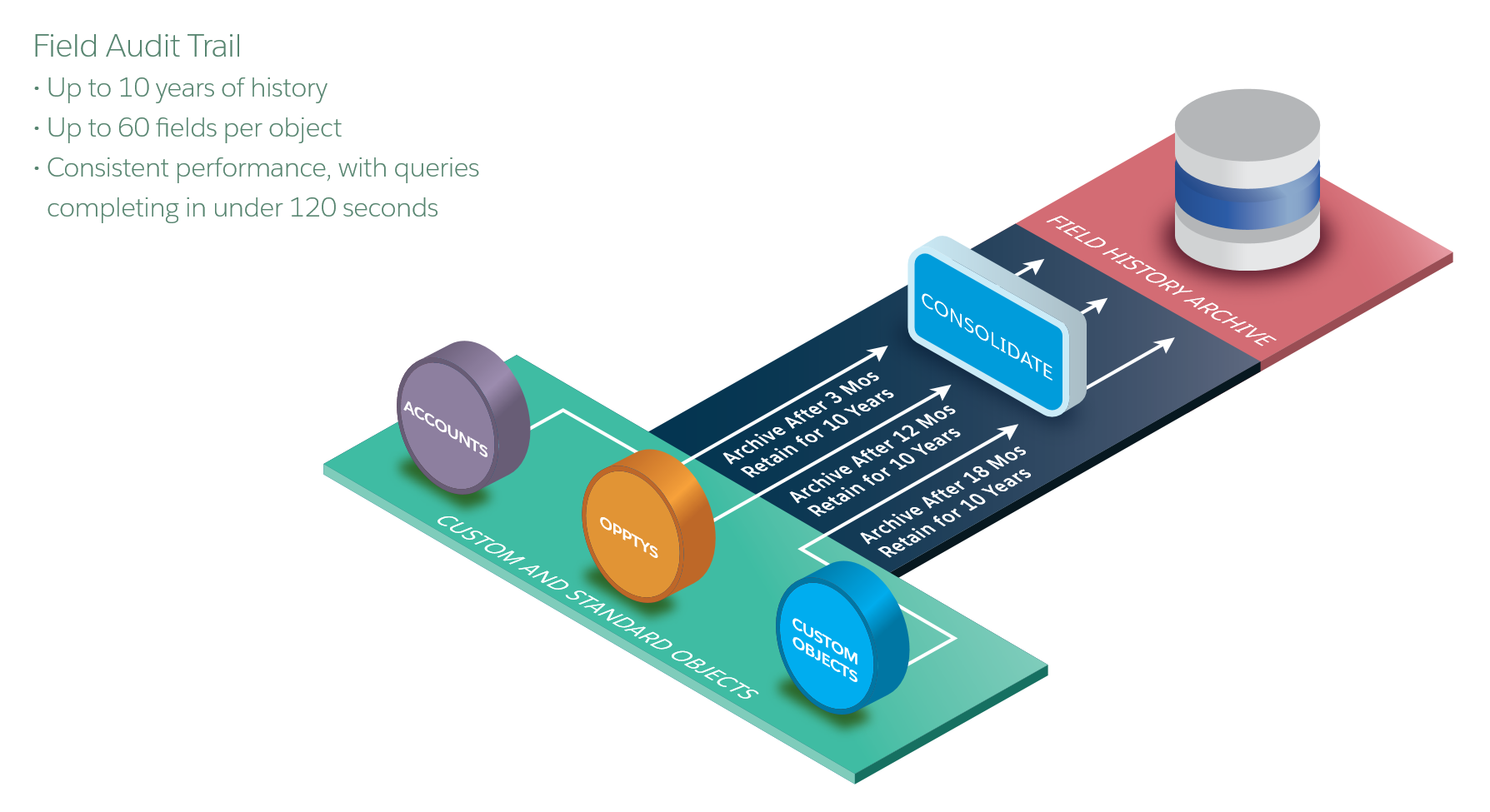
As companies continue to generate and track massive quantities of data, having an effective IT governance strategy in place becomes more and more critical. Salesforce Shield Audit Trail allows users to track the history of various data fields in their Salesforce ecosystem in a far more robust manner. While the field history feature included with a standard Salesforce subscription allows users to track 20 fields for 18 months, Salesforce Shield Audit Trail allows users to track 60 fields per object for 10 years. This is a significant asset for firms operating in highly regulated industries such as financial services. Shield allows firms to extend the utilization of their audit trails while remaining compliant with data retention and audit granularity requirements.
Implementation Considerations:
1) Consult Business Units to Understand Retention and Audit Period / Depth
-
- Firms should first identify their data retention and audit period on a per object basis to understand exactly where and how Audit Trails may benefit their business processes. While the maximum possibility is for 10 years and 60 objects, firms should find the ideal balance between complete oversight and operational efficiency. Additionally, firms should consider the unique regulatory guidelines they must adhere to while customizing the service to fit their needs.
2) Set Retention Policies
-
- Firms should determine which fields and objects should be retained for audit purposes. Additionally, identifying when and how long this information should be archived is a crucial step in a successful implementation of Field Audit Trail.
3) Identify Practices for Retrieving and Auditing Data
-
- Finally, firms should develop best practices for obtaining, maintaining, and auditing this data. Steps such as setting up audit dashboards, defining standardized queries, and providing access to auditors in the permissions settings should be taken to ensure consistent and accurate reporting of Field Audit Trails in the future as well.
Security Benefits Over Standard Salesforce
The Platform Encryption, Event Monitoring and Field Audit benefits that Salesforce Shield brings to users, beyond the basic platform capabilities, offer an effective means of protection against a wide range of cybersecurity threats. Firms can now encrypt large amounts of information in standard objects, track and visuzalize a variety of events in pre-built dashboards, and maintain an audit history of dozens of objects for a decade. Salesforce has recognized that as the cybersecurity landscape continues to evolve, robust and innovative solutions are needed to keep their customers ahead of criminal attacks.
FinServ’s Capabilities
When securing your firm’s sensitive data from increasingly sophisticated attacks, it is crucial to partner with industry experts that understand the most effective solutions available. While Salesforce Shield brings a deeper level of sophistication over classic Salesforce security capabilities, sophisticated technology is only part of the complex cybersecurity equation. FinServ can gather the development requirements and implement the detailed policies and procedures to protect your firm for years to come. An effectively led implementation of Salesforce Shield is the best way to ensure that there is lasting security for your organization as cybercrimes grow more sophisticated and prevalent.
About FinServ Consulting
FinServ Consulting is an independent experienced provider of business consulting, systems development, and integration services to alternative asset managers, global banks and their service providers. Founded in 2005, FinServ delivers customized world-class business and IT consulting services for the front, middle and back office, providing managers with optimal and first-class operating environments to support all investment styles and future asset growth. The FinServ team brings a wealth of experience from working with the largest and most complex asset management firms and global banks in the world.
Controls Meet Cost Savings: Market Data Expense Management Systems
Global market data spend recently exceeded $30 billion per year1. In an increasingly data-driven investment world, market data spend is only expected to rise, as firms seek out new alpha-generating data sets to enhance returns. Additionally, quantitative investment strategies have never been more in vogue with investors; the literal arms race to find better, more powerful data sets is sometimes merely just a struggle to “Keep Up with the Joneses”.
Market data is a critical component of modern fund management; however, wrangling market data expenses has never been more important due to rising costs and increasing complexity. In this article, FinServ will cover:
- Why is Market Data Expense Management Important?
- What Makes Market Data Expense Management Hard?
- What Technology Solutions are Available?
- Complementary Solutions and Services
- How FinServ Can Help
Why is Market Data Expense Management Important?
Market data is a Top 5 expense at most investment managers, but it is often the #1 headache. Although other expenses like employee compensation, real estate, and general technology spend reach similar (or greater) heights, market data expense management often lacks the same direct and consistent level of stewardship. Everyone wants to decrease market data expenses, even though they tend to be the least understood (e.g. complex contracts, metered services) and it is easy to pass the buck on ownership between technology, finance, operations, and the front-office. Strong, centralized control of the market data management process can help firms save millions by eliminating unused and underutilized services; however, even when market data has an organization’s focus, there are several inherent challenges with managing market data expenses without help.
What Makes Market Data Expense Management Hard?
Market data is incredibly costly and difficult to manage due to its complexity. Market data expense managers are tasked with providing structure to market data programs facing an ever-growing list of responsibilities and related challenges. These include managing a variety of execution-focused priorities, while also driving organizational change via strategic initiatives like optimizing data usage/flow and cutting out unnecessary costs. These activities include:
Expense Allocations & Invoice Reconciliation Controls:
- Market data allocations are usually more complex than vanilla corporate expenses. A single invoice could get allocation to some combination of individuals, groups, departments, and/or strategy (e.g. fund AUM-based allocations).
- This requires a clear understanding of the market data services and solutions currently in use, including an understanding of services purchased. How you pay matters as well; any soft dollar payments should be tightly managed along with appropriate firm compliance officers.
- Due to the volume and complexity of market data vendor invoices, the invoice reconciliation process demands a strong technological solution to facilitate daily market data expense management.
Usage Management:
- Keeping track of actual market data usage is required to get a handle of how to cut unnecessary costs. This includes knowing which applications use specific data, how it’s licensed, and when renewals will occur.
- Market data usage and expense reports are required for the business to make informed decisions related to overall needs. This includes a mechanism to track usage and verify that it is in line with the original business objective.
- Mitigate audit exposure as a firm and remediate any compliance breaches. Understand how the firm’s contracted capabilities compare with actual data usage. Determine if licenses exist for all services utilized across the organization?
Strategic Platform Management:
- Review and implement industry best practices for market data expense management.
- Align the overall strategy with the strategic initiatives of the business and technology teams.
- How may the organization optimize market data consumption across the board to reduce costs?
- How many data vendors are currently used?
- Are any services duplicative/redundant?
- Are there any unused/underutilized services?
- Are there better platforms available for meeting corporate strategy?
What Technology Solutions are Available?
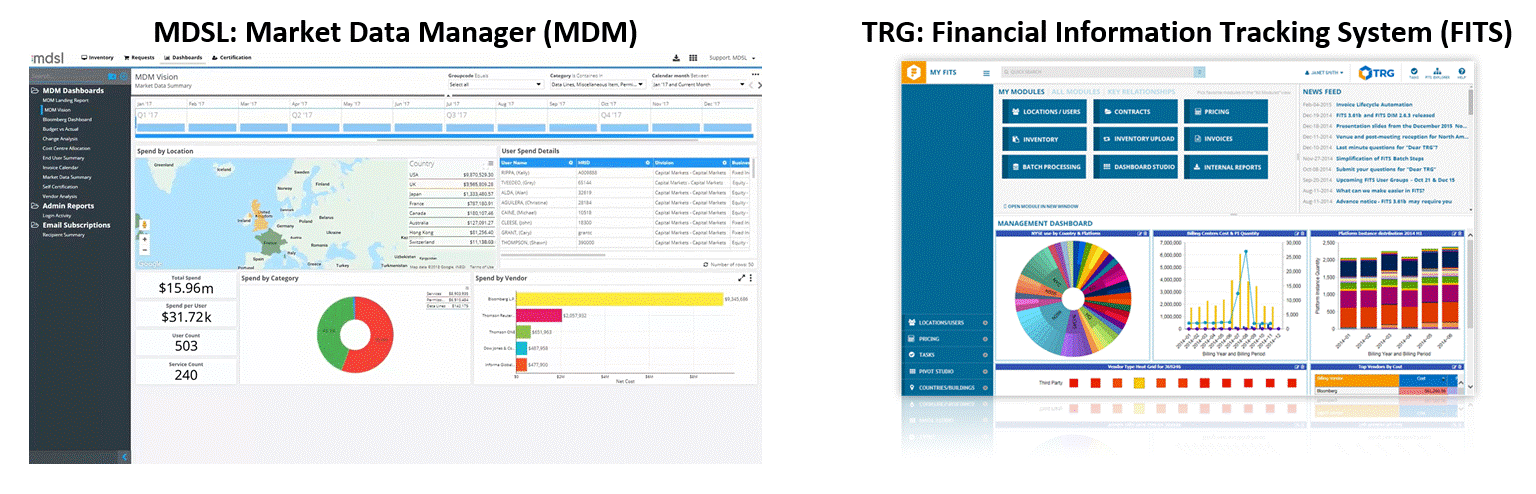
MDSL: Market Data Manager (MDM) and TRG: Financial Information Tracking System (FITS) are two of the leading market data expense management system providers in the financial services and asset management space. The overall landscape has been heavily influenced by private equity merger and acquisition activity. MDSL recently merged with Calero, a telecom expense vendor, and TRG acquired a third player in the market data expense marketplace called Screen: INFOmatch in 2019. Both MDSL and TRG aim to provide structure and clarity to manage firmwide market data, research, software and enterprise subscription spend on subscriptions to market data providers like Bloomberg, Reuters, and FactSet.
- Contract Management and Centralized Inventory: Allows organizations to track, organize, and calculate costs related to market data vendors, contracts, products, and users. Contracts and licensing inventory details may be captured to create a centralized inventory of market data assets for use in invoicing and allocation.
- Compliance Workflow: Compliance approval workflows may be leveraged to review soft and hard dollar eligible costs.
- Invoicing Workflow, Reconciliation, and Allocation: Invoice processing becomes streamlined when matching against structured inventory records. Robust organizational structures may be accommodated to allocate to departments, groups, and/or individual users.
Complementary Solutions and Services
- Managed Services: Both MDSL and TRG offer managed service offerings inclusive of contract maintenance, compliance reviews, and invoice reconciliations. If you are underwater with your current market data expense management process, consider leveraging managed services as part of an initial implementation.
- Usage Monitoring and Control Products: MDSL: Access Compliance Engine (ACE) and TRG ResearchMonitor provide access controls and usage monitoring for subscription services, allowing you to reduce spend on underutilized services and directly ensure compliance with data access contracts/agreements.
How FinServ Can Help
Managing market data expense is often a headache for investment managers, but there are several leading marketplace solutions that help relieve the burden placed on market data managers. FinServ Consulting’s industry expertise and unparalleled track record of service for asset management clients makes us the right partner to help you select the right solution for your organization.
To learn more about FinServ Consulting’s services, please contact us at info@finservconsulting.com or (646) 603-3799.
About FinServ Consulting
FinServ Consulting is an independent experienced provider of business consulting, systems development, and integration services to alternative asset managers, global banks and their service providers. Founded in 2005, FinServ delivers customized world-class business and IT consulting services for the front, middle and back office, providing managers with optimal and first-class operating environments to support all investment styles and future asset growth. The FinServ team brings a wealth of experience from working with the largest and most complex asset management firms and global banks in the world.
Salesforce Spring 20 – The Top 5 Features to Deploy in your Company Today
As with most Salesforce releases, the Spring 20 release which came out for most Salesforce users last week is full of some great new enhancements and features to the system. In this article we will highlight a few of the items we think will be most useful to Asset Managers and Financial Services companies. If you would like more insight into these updates and how to implement them please feel free to contact us at info@finservconsulting.com or by completing our Salesforce inquiry form

# – 1. Lightning Extensions for Google Chrome Browser
Click here to access extension for Google Chrome
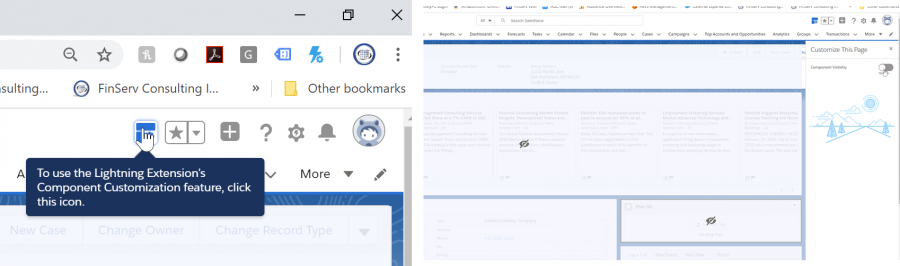
This first feature applies to anyone who uses the Google Chrome Browser only. Now you can install a Google Extension called the Lightning Extension that provides 3 new features. The most useful of these new features is the Component Customization feature which will allow your users to toggle on and off sections of their Page Layout. If there is a section that is never used or if the user wants a streamlined view, they can now quickly make any section invisible on their screen and can toggle it back on if needed.
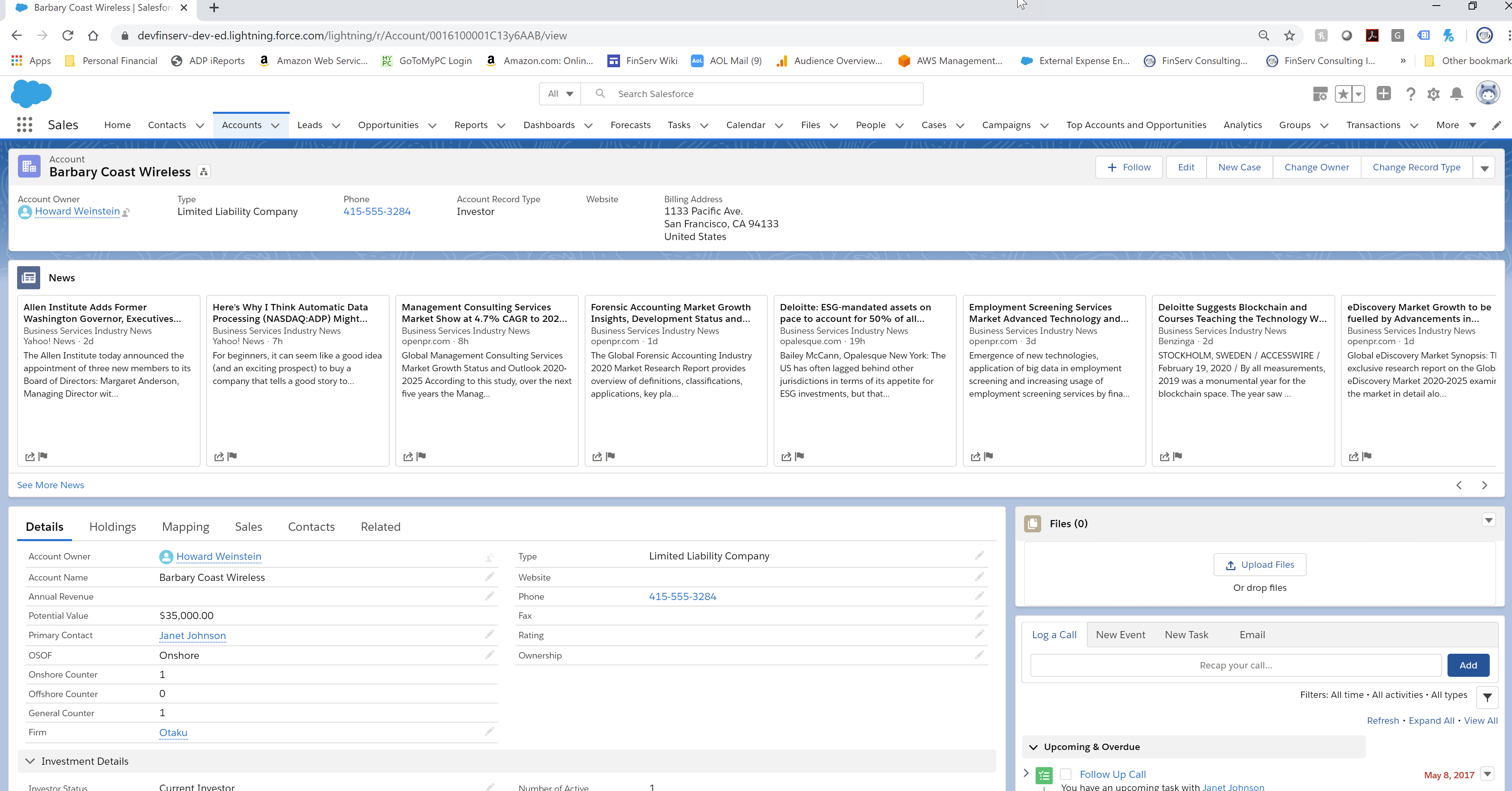
A great example is in the Account Barbary Coast Wireless — we often want to see the latest activity with the client but the File section is taking up the screen so the user can’t quickly see that section right away.
Account Page before enabling new Component Customization
By quickly using the new feature, you see which sections will be hidden (see how its done below)
When you click on the Component Icon the screen will grey out and you will see the components and you can select as shown in the screenshots which ones you have chosen to hide
There are two other less impactful features in this release. One is Dark Mode which is meant to be easier on the eyes when working at night, for instance, and renders the background black. The second is Linkgrabber, which opens every single link you click on in a single browser tab, similar to how the Sales Console works for people who like that feature.
#2 – Lightning App Builder for Mobile
Salesforce has started to push out a real difference maker with their Mobile application, which is increasing the functionality gap between Salesforce and other industry CRM’s like Backstop and Clienteer. For those who have become used to the Lightning Page Builder for the desktop, you will be overjoyed to know that the Page Builder for the Mobile Device has now become General Availability. You can now drag and drop and setup the layout of your pages for your Mobile Device as easy as you would on a desktop. The cherry on top with this feature is the ability to differentiate the layout by device so for smartphones with limited space you can intelligently decide which layouts and features are included in your page setup.
The familiar App Builder with the New Form factor Option to Customize the Layout for any Smart Phone
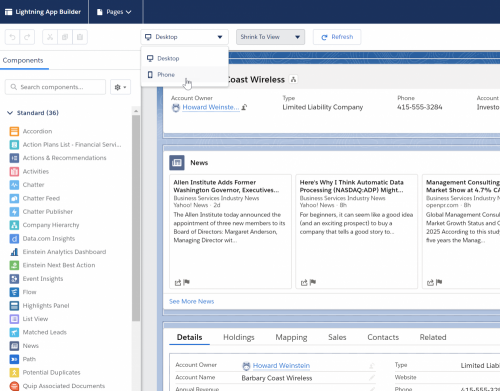
With the new Phone view you get to see the dynamic layout that the user sees on their smartphone.
You can see that the layout is automatically adapted to your phone screen’s dimensions providing a fully responsive experience that Backstop and Clienteer can’t even dream about.
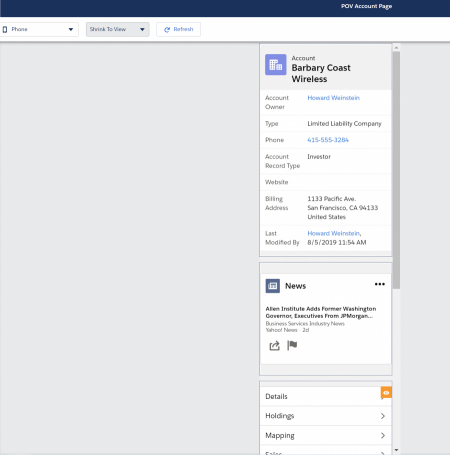
The Filter by Device lets you decide not to show certain components like graphs that may be too big to effectively be viewed on a mobile device.
The below screenshot shows the intuitive and easy to use filter to exclude large components from the phone options

#3 – Email Integration / Opt Out Shown Right in Sidebar
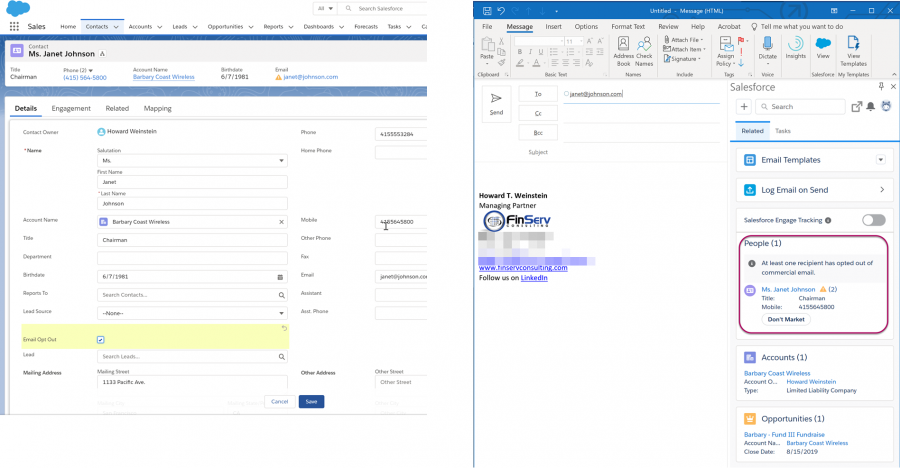
For those who are extensive users of the Lightning Salesforce plugin for Outlook and Gmail, you will love the new feature which highlights when a contact has opted out of emails right in the Salesforce Outlook sidebar.
In the before screenshot below you see Janet Johnson’s contact info showing under People

The first screenshot below shows Janet’s contact record which is updated in Salesforce to indicate that she has opted out of email. You can see in the 2nd screen shot the resulting clear warning — anyone who tries to write Janet an email will see that she has opted out of email. This keeps sensitive investors and investor representatives from getting upset with your sales and marketing teams!
#4 – Report Filtering by Other Fields on the Report
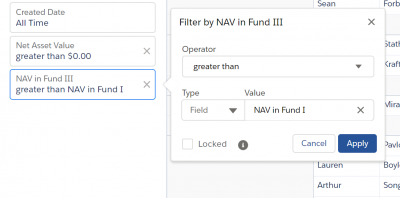
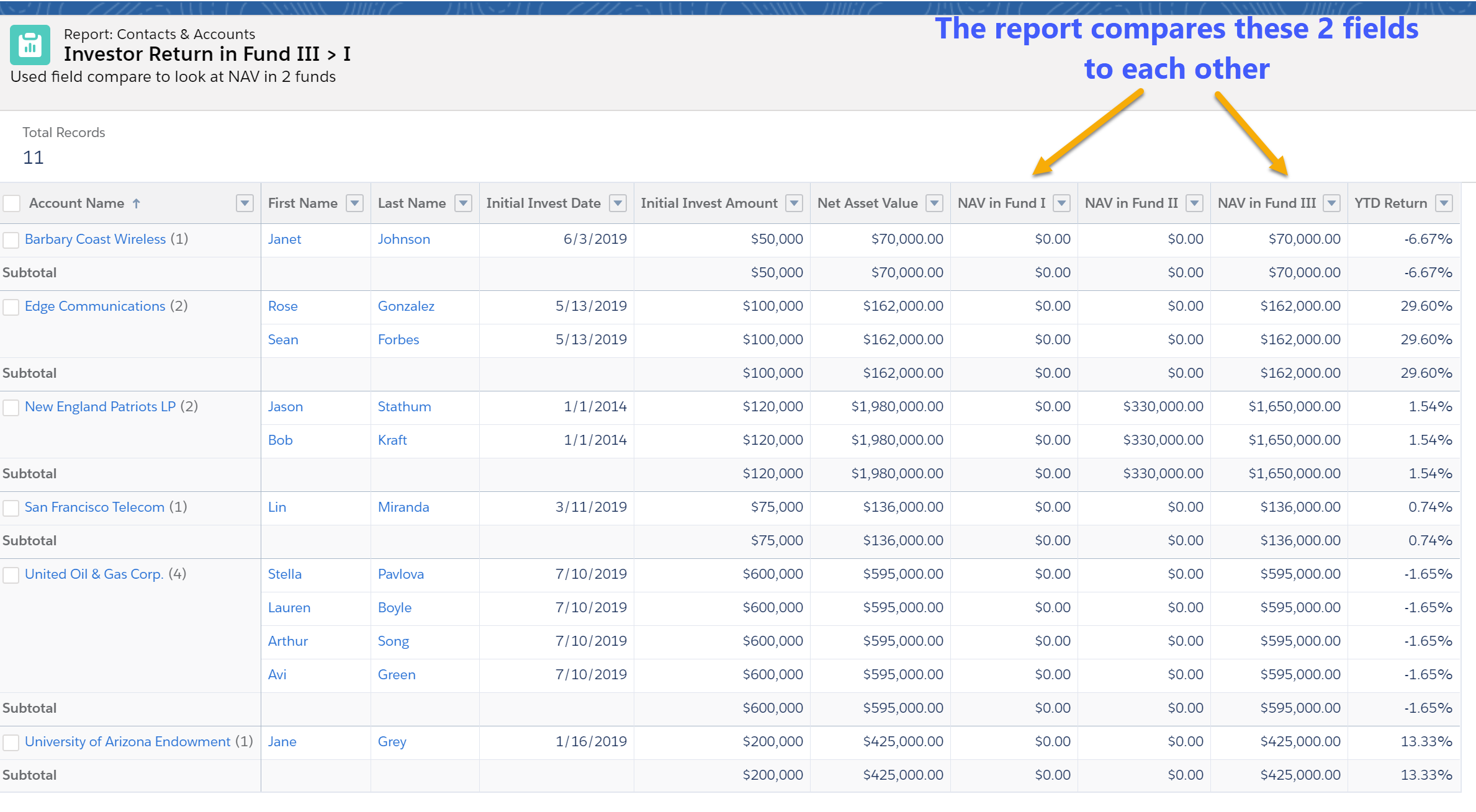
The Spring 20 release has several new features in Reporting. Once of the most useful additions is the ability to add filters to the report that compares other fields on the report.
For example, this can come in very handy if you wanted to compare an Investor’s NAV in an older fund vs. their NAV in a current fund. In my example, the fund has 3 funds and I filtered on the Investor’s whose NAV in Fund III is greater than their NAV in Fund I. The original report had 17 Records but this filtered report just shows the 11 Investors who meet the refined criteria.
The screenshot below shows the user friendly filter screen with the new option to choose the filter type of Field instead of a literal value
#5 – URL Links with Prepopulated Values (not for mobile app)
This next item is one of those features advanced users loved in Classic that was lost in Lightning during the transition. Thankfully, Salesforce has been working diligently to bring back the most popular features to Lightning as Classic is very close to its end of life.
This feature allows you to create a URL link that includes prepopulated values for any field in the object, which will save time when creating a new record. For instance, if your Sales and Marketing teams are at an Investor roadshow and they are meeting new Investors, they will want to create new Contacts quickly since there are often many fields that are always the same entry in a Contact. By creating a clickable URL link to start the new Contact from the Account Page for the Investor, the new Contact can be prepopulated with as many of the fields as you want. Some of these may be placeholder values, while others are real values that never change but previously had to be manually entered or selected.
The syntax to set this up is a bit tricky so we recommend you seek help from us or your IT department if you are not experienced in HTML as you need to create a query string and place the field name and the value you want entered separated by a comma. You use lightning/pageReferenceUtils module to build navigation links that prepopulate a records’ create page with default field values. Prepopulated values can accelerate data entry, improve data consistency, and otherwise make the process of creating a record easier.
How: To construct a custom button or link that launches a new record with prepopulated field values, use this sample formula:
/lightning/o/Account/new?defaultFieldValues=
Name={!URLENCODE(Account.Name)},
OwnerId={!Account.OwnerId},
AccountNumber={!Account.AccountNumber},
NumberOfEmployees=35000,
CustomCheckbox__c={!IF(Account.SomeCheckbox__c, true, false)}
Link to New URL Link Description
Conclusion
As you see there are many exciting features included in Salesforce’s Spring 20 release. FinServ Consulting, a top Salesforce Partner with a focus on the Asset Management sector, ensures our clients take advantage of the most important features and maximize their investment in Salesforce.
If you are interested in any of these features and want help implementing them or just have a question about them, please contact us here or by email at info@finservconsulting.com and we would be happy to help.
About FinServ Consulting
FinServ Consulting is an independent experienced provider of business consulting, systems development, and integration services to alternative asset managers, global banks and their service providers. Founded in 2005, FinServ delivers customized world-class business and IT consulting services for the front, middle and back office, providing managers with optimal and first-class operating environments to support all investment styles and future asset growth. The FinServ team brings a wealth of experience from working with the largest and most complex asset management firms and global banks in the world.
Preparing for Salesforce Blockchain
Salesforce Blockchain was only announced in May 2019 and at Dreamforce 2019, it was announced that Lamborghini, the premier maker of exotic super cars, was using Salesforce Blockchain to authenticate its previously owned (aka heritage) cars. Lamborghini represents yet another major early adopter of Salesforce Blockchain in a short amount of time since its release. Salesforce Blockchain will not be available to the general public until 2020 and it already has been rapidly implemented by early adopters such as Arizona State University, IQVIA, S&P Global Ratings and now, Lamborghini to gather and share massive amounts of data with an expanding and increasingly complex network of partners and third parties.
What is Salesforce Blockchain?
To define Salesforce Blockchain properly, we must look at what Blockchain is overall and its underlying components. Blockchain is a distributed decentralized digital ledger spread across a network of computers securely storing transactional data. Core features include:
- Distributed Decentralized Digital Ledger – the digital ledger stores transactions such as the transfer of funds across a network of computers rather than a central source
- Peer to Peer Network – the network is comprised of a partner network (only accessible to members) who all save and maintain the transactional data
- Data Verification – data is verified using cryptography and digital signatures to authenticate identities and transactions
Salesforce Blockchain takes all of the interconnected and complex components of Blockchain and makes it accessible to the general users. It is a low code platform built on Lightning and open source Blockchain technology from Hyperledger Sawtooth. It is designed to make building and managing trusted partner networks, workflows and contracts possible with clicks and not code.

“Blockchain is changing the way companies approach trust and transparency,” said Adam Caplan, SVP, Emerging Technology, Salesforce. “Lamborghini is a perfect example of this—we’re excited to see how such an iconic brand is able to innovate and transform the vintage car market with a cutting edge technology like Salesforce Blockchain.”
Per Salesforce’s News Release, Salesforce makes Blockchain more accessible and even more powerful through the following:
- Build Networks with Clicks — Drag and drop ready-to-use modules to build their own blockchain networks with minimal need for writing code.
- Automate Data with Lightning Platform — Make blockchain data actionable through native integration with Salesforce. Layer complex blockchain data on top of existing sales, service or marketing workflows like search queries and process automation. Even more, companies can now run Einstein-powered artificial intelligence algorithms that integrate blockchain data into sales forecasts, predictions and more.
- Engage Partners Easily—Lower the barrier to entry for partners, distributors and intermediaries to leverage Salesforce Blockchain. Companies can now pull in APIs, pre-built apps and integrate any existing blockchains with Salesforce. With an intuitive engagement layer, companies can also easily interact with and add third parties to their blockchain with a few clicks and a simple authentication—creating trust networks.
Lamborghini Salesforce Blockchain Usage
Lamborghini recognized the benefits of Blockchain and how Salesforce enabled them to achieve those desired Blockchain benefits. Using Salesforce Blockchain, they took on the challenge to improve their heritage cars certification process. Heritage cars are previously owned cars that when resold, must go through an extensive and exhaustive process to certify that the car is 100% Lamborghini.
“When a Lamborghini is resold, the vehicle often goes through 800 to 1,000 certification checks that take place at the Lamborghini headquarters in Sant’Agata Bolognese, Italy,” according to a press release published by Salesforce.
The certification process requires that Lamborghini coordinate a vast network of participants – technicians, repair shops, dealerships and more – to verify the provenance and authenticity of the vehicle. To improve the speed and efficiency of the certification process, Lamborghini digitized the process by creating a trusted network among the certification process participants in Salesforce Blockchain.
“Innovation has been at the core of our company since its founding,” said Paolo Gabrielli, Head of After Sales at Automobili Lamborghini. “Salesforce Blockchain will allow us to take our innovation a step further, accelerating the authenticity of our heritage vehicles faster than ever.”
In addition to speeding up the certification process, Salesforce Blockchain has layered on the inherent security of Blockchain into the process. All authentication checks are managed by Lamborghini and its trusted partner network where each partner in the Blockchain has access to the entire database behind the car from parts, service, history and verifications. Full data transparency with decentralized data renders counterfeiting practically impossible.
Usage in the Alternative Asset Management Industry
The quality of early design partners and what Lamborghini has been able to do with Salesforce Blockchain has shown that Salesforce Blockchain is a powerful product that will have practical application to any number of organizations, especially alternative asset managers.
Consider the following questions outlined by Salesforce to think about the potential use case of Blockchain at your organization. (https://www.salesforce.com/blog/2019/05/what-is-blockchain-technology.html)
- Do you want to solve a business problem, rather than an integration problem? Blockchain is at times mistakenly positioned as an integration technology, but that’s not a core strength. If integration’s your goal, you may be better off using an API, Enterprise Service Bus (ESB), or web service.
- Does your business process require inherent irreversibility? This quality is foundational to blockchain, so ask yourself whether it would help you achieve your business objective or hinder it.
- Do you want to transfer objects of value from one party or entity to another? If this is the case, consider whether what you intend to do will benefit from immutability. Also, does it require consensus? If the answer is “yes,” you might benefit from using blockchain.
- Do you want to transfer information across organizational boundaries? If your use case involves some level of managing cross-organizational trust, deploying blockchain can help. It can also be useful if you want to simplify the process between you and upstream or downstream business partners.
- Do you want to target an ecosystem, rather than a few parties? Consider whether the problem you want to solve requires (significantly) more than two participants. If it is just a handful, integration might be the way to go. If you are targeting an ecosystem, blockchain may be the right choice.
- Do you have a clear strategy for engaging and driving adoption with partners? Without their adoption of blockchain, the positive impact to your business will be limited.
With the above questions in mind, a high impact and practical usage of Salesforce Blockchain could be in streamlining the Investor Onboarding process, typically a laborious and inefficient process bound by repetitive tasks and adhering to rules and regulations such as:
- KYC (Know Your Client) Verification – working with multiple parties to review and verify specific pieces of data such as proof of identity, source of funds, legal structure, sanction and watch list screening, etc.
- Client Suitability Verification – working with clients to confirm their suitability for investing in a fund under FINRA Rule 2111 or MiFID II guidelines (i.e. investments are in line with their risk tolerance and ability to bear losses). As client situations can change, investment suitability must be continually reassessed
Bringing the KYC and Client Suitability Verification process into Salesforce Blockchain expedites the process by bringing all parties and the associated reviews together in one trusted network. Once the data is in one network, it can be shared with Salesforce CRM enabling process automation and AI insights into the process. In addition, it also enables a fully transparent review process that is inherently auditable.
Summary
Salesforce Blockchain is a major focus of Salesforce to enable their clients to easily avail themselves of this paradigm changing technology. Salesforce believes in clicks, not code and has brought this model to Blockchain. For the early adopters of Salesforce Blockchain such as Lamborghini, Salesforce Blockchain has shown itself to be an indispensable feature of Salesforce. To prepare for Blockchain, FinServ can help in mapping out your current processes and planning out what can be put into Blockchain. If you would like help with planning or implementing this, or just get more info or a demo on these features, FinServ would love to help. You can reach us at info@finservconsulting.com or give us a call (646) 603-3799.
About FinServ Consulting
FinServ Consulting is an independent experienced provider of business consulting, systems development, and integration services to alternative asset managers, global banks and their service providers. Founded in 2005, FinServ delivers customized world-class business and IT consulting services for the front, middle and back office, providing managers with optimal and first-class operating environments to support all investment styles and future asset growth. The FinServ team brings a wealth of experience from working with the largest and most complex asset management firms and global banks in the world.