
Move Your SaaS, to Optimize It!
Common Reasons SaaS Applications Aren’t Being Optimized
Software as a Service (SaaS) is a method of software delivery and licensing in which software is accessed online via a subscription, rather than purchased and installed on individual computers. These web-based solutions make it convenient to perform business on any computer, tablet or smart phone. Applications can be as simple as Microsoft Excel (via Office 365) or they can be more complex to allow business lines to manage their data and business processes, securely. The software and servers are maintained by the vendor, which makes these applications attractive to business lines such as Human Resources, Finance and the IT folks that normally support these groups. However, if the software isn’t configured correctly during the initial implementation or maintained to keep up with frequent version updates then you aren’t optimizing your SaaS and getting the best return on your investment. Following are common reasons why we see firms not optimizing their SaaS applications:
- Over-purchased Functionality – Often, as part of the original software license negotiation process the client purchases more functionality than can reasonably be implemented in the time-frame budgeted. Sometimes functionality is rushed and rolled out just for the sake of putting it into play, whether it was designed correct or not. In other cases, functionality is shelved for later so that the core implementation can be rolled out to meet the project deadline and budget. Implementation projects are typically scheduled to complete in time for an old system to be replaced and/or just prior to the business having to enter their busy season. As a result, any functionality not completed usually gets placed on the back-burner and in some cases it never gets implemented.
- No Maintenance Program – The SaaS vendors change the software with each version upgrade, release schedules varying by vendor but some releases happen quarterly. As the software change, chances are so does your business. Each version release should be viewed as a mini-implementation project. Some changes are forced on all users whereas some are optional and they need to be configured in order to take advantage of them. If the business isn’t actively monitoring the functionality that is being released, reviewing it against their business needs and activating the optional enhancements, then the software isn’t being maximized.
Helpful Things to Know About SaaS Applications
- Usually software license fees begin when the contract is signed, not when the software is implemented in production. There is a negative return on investment until the system is implemented and being used. A delayed or extended implementation continues to eat into the return on investment.
- These applications are typically highly configurable, they are not custom. The application is designed to work for the masses so in some cases functionality doesn’t work as desired. Fully understand your business needs and match them to the system functionality to ensure it will work for you before you purchase it.
- The software is maintained by the vendor, however new functionality and changes to existing functionality are released on a scheduled basis. Some functionality is forced on all users whereas some functionality is made available through additional configuration. Make sure you have the resources who know your business and the technology being used.
Recommendations to Optimize Your SaaS
- If you are negotiating a contract with a SaaS vendor, consult with an experienced implementer to confirm the reasonableness of implementing the modules being purchased. A high-level discussion of your requirements can help determine if a module will work for your firm. Also, be careful of biting off more than you can chew. Don’t purchase modules that you can’t implement in the near term as you don’t want to pay recurring license fees on software that won’t be used. An experienced implementer can guide you on the core functionality that needs to be implemented at first and what functionality can be implemented later. In most cases it’s best to work with the core functionality first to help you understand it better, before venturing into new features.
- If you haven’t been maintaining the software version releases, develop a plan and assign the proper resources who know the business and the software. If you don’t have an internal resource who can be assigned to this, there are several vendors who offer this service. However, the best practice is to assign someone internal to your organization who knows your business.
- If you haven’t reviewed the system functionality in 12 months, consider hiring a vendor to perform a gap analysis and/or operational assessment to review your current business needs compared to the current system functionality and best practices.
To learn more about FinServ Consulting’s services, please contact us at info@www.finservconsulting.com or (646) 603-3799.
About FinServ Consulting
FinServ Consulting is an independent experienced provider of business consulting, systems development, and integration services to alternative asset managers, global banks and their service providers. Founded in 2005, FinServ delivers customized world-class business and IT consulting services for the front, middle and back office, providing managers with optimal and first-class operating environments to support all investment styles and future asset growth. The FinServ team brings a wealth of experience from working with the largest and most complex asset management firms and global banks in the world.

Engage Your Workday HCM Users
When a customer implements Workday Human Capital Management it’s often an exciting event for the Human Resources team but can be an underwhelming experience for the firm. For Workday Human Capital Management customers we’ve seen them struggle to increase user engagement. Implementing Workday is a significant investment so it can be frustrating if there isn’t a sense that it’s used firmwide. Customers that have Workday Financials or Payroll in addition to Workday HCM tend to have higher user engagement. It’s much more frequent that an employee will log into Workday to submit an expense than to update their home address. For those HCM customers that are looking for ways to increase user engagmement, FinServ has a few tricks that have worked for our clients:
- Explain the impact. Oftentimes the best way to get employees to complete the task you’re asking of them is to explain why you need them to do it. For instance, if you explain to an employee that they need to complete all their tax forms before they can be paid, you’ll likely have a much higher rate of success among your employees.
- Create a winner. A sure way to increase user engagement is to create an incentive for employees. For example, you can hold a raffle for those employees that enter information you’ve requested. Our clients have had success when asking employees to update their education or career history and entering employees into a raffle for completing their profile.
- Make the ask easy. Of course if you want your employees to use the system (and like it too) you’ll want to make sure their experience is painless. We suggest leveraging Workday functionality at every opportunity. For instance, if you want employees to update part of their profile, leverage the business process Distribute Document or Task. This will send the task, like updating your Education history, directly to the worker’s inbox so they can easily execute the task without having to navigate to their worker profile.
- Lastly, include ample instructions. There are many opportunities to include instructions and we encourage our clients to be very explicit. For instance, if you distribute a task, include a customized instructions on how to execute the task. For very detailed instructions, we include a link in our email notifications that brings an employee to a PDF with screenshots on how to complete the task. When creating the task in Workday you are also able to include instructions that will then appear in the worker’s inbox.
FinServ has helped many clients increase their user engagement and demonstrate the ROI for their Workday HCM platform. We also work with clients to plan their annual Workday initiatives, build new functionality, and maintain their system security. To learn more about FinServ Consulting’s services, please contact us at info@www.finservconsulting.com or (646) 603-3799.
About FinServ Consulting
FinServ Consulting is an independent experienced provider of business consulting, systems development, and integration services to alternative asset managers, global banks and their service providers. Founded in 2005, FinServ delivers customized world-class business and IT consulting services for the front, middle and back office, providing managers with optimal and first-class operating environments to support all investment styles and future asset growth. The FinServ team brings a wealth of experience from working with the largest and most complex asset management firms and global banks in the world.
Why Funds Who Want to Grow Must Continue With Their Strategic Projects
As an experienced surfer knows, if you wait until the wave is on top of you, then your chance to ride that wave is already gone. The same can be said about when an alternative asset manager innovates and invests in new technologies and projects during periods of low performance like we have seen recently.
As Klaus Schwab Founder and Executive Chairman of the World Economic Forum (“WEF”) noted, “Typically, first-adopters of technology are the ones with the financial means to secure it, and that technology can catapult their continued success increasing the economic gaps.”
He went on to say, “Additionally, the changes might develop so swiftly, that even those who are ahead of the curve in terms of their knowledge and preparation, might not be able to keep up with the ripple effects of the changes.”
Overview of This Paper
We will look at what companies did during the recession of 2008 to identify historical trends. We will also examine recent surveys that suggest where Investors are focused as they evaluate Hedge, Private Equity and other Alternative Asset managers in 2019 and beyond. Finally, we will highlight information from our own client data to explain how our clients followed these trends and share how those funds performed in terms of their own growth or decline.
Our Thesis
The underlying assumption to our work is that the economy and the market will recover and so will the asset managers who possess strong fundamentals. Given this premise, it would be very hard to argue that putting your strategic projects on hold is a good business decision if you want to stay relevant in an increasingly competitive landscape.
We look at surveys performed by EY and KPMG which back what most fund managers already know. Investors are focused on allocating their money to Innovative Funds who have strong cost management approaches in place, and who are leveraging the latest and greatest technologies.
Finally, we speak to the usage of technologies like AI, Big Data and RDP which are indispensable in the 4th industrial revolution and support the conclusion that funds who have not embraced these technologies will lose out to more innovative managers.
Our Recommendation
Based on this evidence, the only possible course of action is that funds must continue to push forward with their strategic and cost management projects undaunted by current fund performances. This is critical to not just to survive, but thrive and grow in the fast-paced and constantly evolving technical golden age we now live in.
Klaus Schwab who coined the term the 4th Industrial Revolution explained that, “Typically, first-adopters of technology are the ones with the financial means to secure it, and that technology can catapult their continued success increasing the economic gaps. Additionally, the changes might develop so swiftly, that even those who are ahead of the curve in terms of their knowledge and preparation, might not be able to keep up with the ripple effects of the changes.”
We believe in this statement Mr. Schwab accurately warns businesses that a pause in innovation can be very costly to their competitive position in the marketplace.
Why a Reactive Response to Poor Fund Performance Can Amplify its Impact
While it is totally understandable that a prudent CFO, CTO or COO will place all projects on hold during periods of uncertainty and poor fund performances, the loss of momentum is far too costly to allow this to happen. This pause will only multiply the impact on your funds’ future performance by handicapping your investment team from performing their jobs at an optimal level.
There appear to be two basic camps on this question. One side argues that companies should double their innovation efforts in recessionary times. In March 2008, American Express CEO Ken Chenault was quoted in Fortune saying, “A difficult economic environment argues for the need to innovate more, not to pull back.” [1]
What we have seen firsthand at the top performing funds is the exact opposite mentality. The top funds never stop working on the most important strategic projects to their business. In fact, what we have witnessed in most cases is when the markets are in question they double down on their investments, because they want to be able to take advantage of the funds who are too scared to make moves and enhance their market dominance.
They know from experience that when others are cautious and holding back, they can seize on opportunities more easily to extend their dominance.
Historical Support for Investing in Disruptive Innovations During Economic Contraction
Supporting the concepts of the 4th industrial revolution, FinServ believes the pace at which new technologies are being offered to funds in our industry is at a pace that we have never seen before. We believe adopting solutions like AI and RDP without delay is essential to succeed during these down periods in performance.
As we researched historical data to support our thesis, we came across many examples and anecdotes that support the idea that innovation during hard times is the best course of action. Here is one example provided in 2001.
The EY study further backs up the case for innovation supporting the idea that tactical short-term fixes are always important, but it should never be prioritized or replace the long-term, strategic investments that fund managers must continue to focus on in a highly competitive marketplace for investors. We’ll explore a few examples of these innovations as it relates to alternative asset managers later.
Strategic, long-term actions are more successful in protecting margins
It feels like an intuitive finding, but the data is clear. Those managers who indicated that they were taking strategic, long-term actions are more likely to report that their margins increased in the past two years.
Only 19% of those managers who indicated they were taking tactical, short-term actions increased margins as compared to 62% who indicated margins decreased. This compares to managers who took strategic actions of whom 32% reported margin increases and only 36% who had margin compression.
Margins are influenced based on both top-line revenue growth as well as cost management, all while making necessary investments to support the overall growth of the business. With resources less abundant for most managers, business leaders need to critically analyze their operations and take actions to best prepare the organization for both the current and future landscape. Acknowledging that the industry is being disrupted and taking advantage of newfound opportunities will best position innovative and forward-looking managers to deal with challenges and competition.
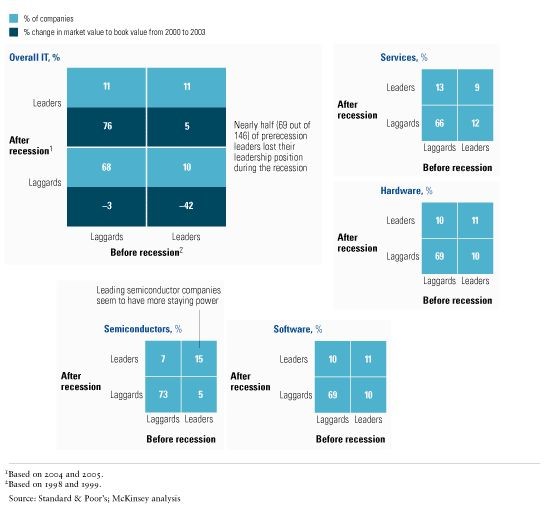
A study performed by McKinsey in the high-tech industry that backs up this point. In their analysis below they reinforce the point made by Klaus Schwab, that if you hesitate you will be left behind, but if you innovate you will surge ahead. The evidence suggests that if you hold back you can very quickly lose your position in the marketplace and go from a leader to a laggard.
“We found, for example, that 69 of the 146 high-tech companies entering the 2000–02 contraction as leaders—47 percent—emerged from it as laggards (Exhibit 3).
Conversely, 13 percent improved their positions during that same period. For example, the last downturn saw several leaders in various subsectors slip, from storage device makers and enterprise software manufacturers to virtualization and consulting-services firms. In contrast, companies such as Foxconn and HCL ascended.
Even companies that remained in the same categories moved to the extremes: Cisco Systems and 3Com, for instance, continued to be a leader and a laggard, respectively, but Cisco’s performance improved while 3Com’s fell further (see sidebar, “Cisco: Exploiting a recession’s dynamics”). With so much change in the sector’s leadership, it’s not surprising that we found that the market-to-book values of leaders and laggards changed significantly—by 40 to 80 percent from prerecession values. The current crisis could exacerbate the sector’s volatility.” [1]
Cisco: Exploiting a recession’s dynamics
While many competitors of Cisco Systems retrenched during the 2000–02 high-tech slide, Cisco invested in the downturn through prudent M&A moves, simultaneously scaling up and streamlining. The company made 16 acquisitions for a total value of almost $15 billion, rounding out its portfolio in areas such as systems design (a large stake in Sigma Systems). It also shed noncore assets, such as a consulting unit in Europe.
Cisco then took decisive steps to increase revenues and cut operating costs. To gain market share, the company reduced prices and shored up customer relationships by allowing deferred payments on purchases. At the same time, it aggressively cut operating expenses by more than $2 billion—in part through redesigning products to use less costly parts and slashing its supplier base by 50 percent to extract bigger discounts from remaining vendors. These actions allowed Cisco to extend its leadership against competitors such as 3Com, which reportedly reduced its headcount by 50 percent (versus Cisco’s 20 percent), froze acquisitions, and divested a valuable asset—Palm—to raise cash. By contrast, Cisco’s cash discipline allowed it to buy back stock even as it stepped up acquisitions. [2]
Another Strong Argument to Invest in Market Downturns
During these market downturns, vendors will offer clients extra incentives to move deals forward, including cost concessions. This is something funds can really leverage, sometimes even locking in long-term preferred rates. Another thing we have seen is when projects are slower at these firms, you are much more likely to get their best talent on your project.
At the end of the day, it is all about supply and demand. If you are brave enough to spend money during shakier times, you will no doubt be able to complete your projects, purchase software and other services at a more advantageous cost than when the rest of the market is buying with you.
FinServ’s Client Experience During Periods of Market Turmoil
As a consulting firm who lived through the 2008 financial crisis, we experienced first-hand how our client base reacted to those catastrophic events. We observed how many of our clients put all projects on hold and pulled back on all work immediately. We witnessed far fewer continue with their most strategic projects undaunted by the potential collapse of the markets.
Of course, the current situation is far from the dynamics of the financial crisis, but we are seeing a general pause on existing projects and slowdown in new projects at many investment firms since the middle of 2018.
Without exception, our clients who chose to continue with their projects during the crisis greatly expanded their businesses and exponentially grew their AUM over the following years. We believe this was because they never stopped their projects and kept the momentum in the innovations. This left them in a much better position to take advantage as the markets rebounded.
This was not only investment in projects or software, but also in new hires and training as well. With many funds cutting back, the number of desirable and experienced candidates in positions like fund accounting had a rare instance of supply far surpassing demand, resulting in many key, valuable hires made during that time.
In an industry where the most knowledgeable resources are so hard to find and hire, this was a rare time when finding qualified candidates was far less challenging.
The Current Alternative Asset Management Environment
Over the past several years, it has become increasingly difficult for funds to compete for new investors and achieve superior returns. As this competition continues to increase, funds are searching for the differentiators that will compel investors to choose their funds.
Based on our own experience, the rigorous due diligence process that most investors put fund managers through today presents challenges in two key areas which is backed up by several studies: technical innovation and cost management.
Technical Innovation – Prospective investors have been clear when performing their due diligence to look for funds who are innovators and utilizing the latest and greatest technologies to achieve superior returns and to effectively manage risk.
The days of investors just providing money without scrutinizing the investment process is gone. The survey by EY substantiates the understanding that although investors may not explain why they require this, it is absolutely critical that the funds who want to continue raising capital must be leveraging technologies like AI, RDP, big data and other innovations.
As a professional with over 25 years in consulting, I have worked through many different economic cycles. Often during the downturns, I have seen clients shift their focus toward compliance-related or non-discretionary projects, and away from more strategic or innovative efforts. In fact, this is the opposite of what funds should do based on investor requirements, and below is great evidence for why.
Continuing to prioritize innovation efforts in recessionary periods requires strong senior leadership. The overwhelming tendency is to slash resources, shut down long-term investments and focus on incremental improvements. Taking the wrong actions can sharply inhibit a company’s ability to reach its long-term strategic objectives. Approaching the problem in the right way can allow companies to do more with less and continue to move forward.”1
As FinServ has worked closely with our clients they have shared many stories of the most common and consistent questions asked during the due diligence process. A few years ago, there was a tremendous focus on risk management and controls in key operational processes and a push to ensure external third parties like third party administrator was validating the funds’ financials. Over the past year or so, there has been a significant shift towards understanding a funds technology stack and what new technologies they are utilizing in their investment process and in their operations to effectively support cost management.
The EY study further supported our experience as well.
“Investors believe advanced technology and data in the front office are important … but few have been able to quantify the benefits.
As the industry becomes more familiar with the use cases of artificial intelligence and alternative data, investors are increasingly coming to expect that asset managers will leverage it. Many view these tools as attractive complements to the manager’s existing investment process which can lead to alpha generation … although few investors can actually prove it.
Investors reported that 30% of their 2018 allocations are to managers using next-generation investment tools or data with an expectation that these allocations will grow to over 40% in the next two years. Investors are continuing to trend in the direction of expecting AI or alternative data to be used, and where it is not, managers may need to justify the rationale.
Those managers who are not embracing these techniques need to ask if they and their investors are comfortable with the status quo or if there are potential benefits.” [1]
3 At the tipping point: Disruption and the pace of change in the alternative asset management industry, 2018 Global Alternative Fund Survey
https://www.ey.com/us/en/industries/financial-services/asset-management/ey-2018-global-alternative-fund-survey
- Cost Management – At the same time, investors continue to add pressures to funds to be much more effective at managing their own operating costs. Investors want assurance from the funds that their operations are efficient. Again, investors are being more intrusive in this area, insisting that funds demonstrate a focus in technologies like AI, Robotic Process Automation (“RPA”) to meet this expectation.
The McKinsey study backed up this same focus on investment in the business operations:
“The companies in our study managed their sales, general, and administrative (SG&A) expenses in a much different way than anything else we investigated. Controlling operating expenses is critical for all companies, but leading ones that maintained their positions in the 2000–02 recession actually increased their SG&A costs by 6 percent more, in absolute dollar terms, than leaders that lost their positions (Exhibit 4). Some leaders that maintained their leadership also raised overall headcounts by 2 percent; fallen leaders cut them by 8 percent. The growth in SG&A expenses and employees took place even as sales for most leaders declined by 5 percent. A leading software firm, for instance, increased its advertising expenditures from $1.23 billion in 2000 to $1.36 billion in 2001 as the market softened. And SAP ramped up sales and marketing spending by 19 percent in 2001, although it cut administrative expenses by 8 percent. In contrast, a software competitor that slipped somewhat cut approximately 2,000 sales and marketing employees.” [1]
Who is Implementing These New Technologies
As a consulting firm that services the Hedge and Private Equity Fund markets, we have seen that the two alternative asset management approaches have different levels of systems requirements, as well as experience levels of investing in technologies.
Hedge funds tend to have far more complex needs, demonstrating a propensity to invest in and adopt new technologies well ahead of most private equity firms. However, we have seen over the past several years that many of our private equity clients are beginning to push into the newer technologies like AI and big data at an increasing rate.
The Private Equity Story
A KPMG paper which focused mostly on digitization technologies correctly points out that while Private Equity firms have been slow to adopting new technologies, they do have just as much, if not more to gain from investing in them.
This is because Private Equity firms can not only apply the solutions to their own investment process, but also to their portfolio companies, thus offering a huge return in terms of efficiency by leveraging the same technologies. Applying these technologies to their portfolio company reporting requirements also aids in the transparency for their investors. Investors preferred private equity firms who utilized advanced technologies to report performance on their investments as they saw this as evidence of a strong set of fund operations and effective controls. Additionally, investors looked very favorably on fund managers who brought the latest technologies to their investment portfolio to enhance their investments value and efficiency as well.
KPMG’s analysis corroborates this finding with the following charts.
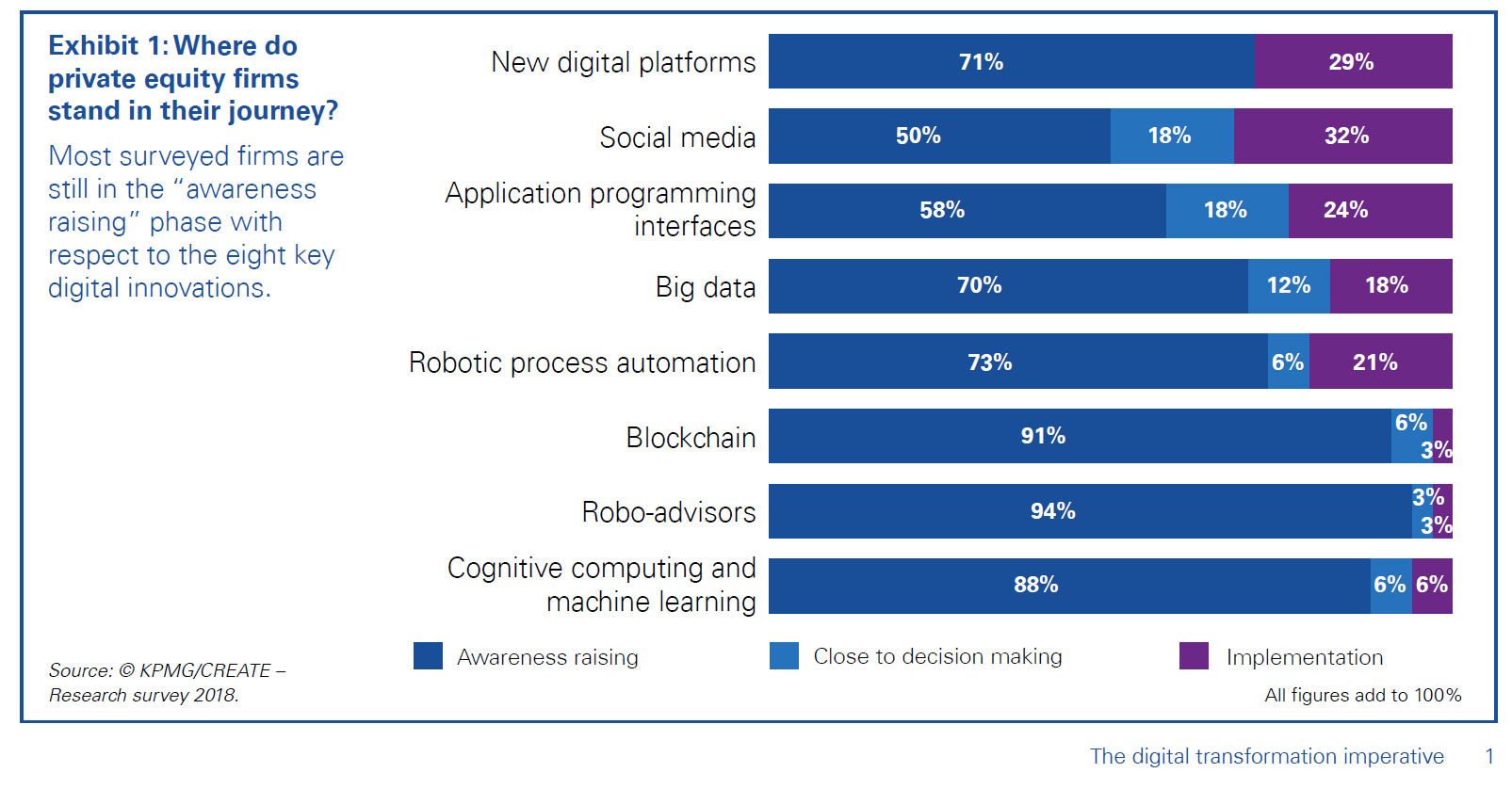
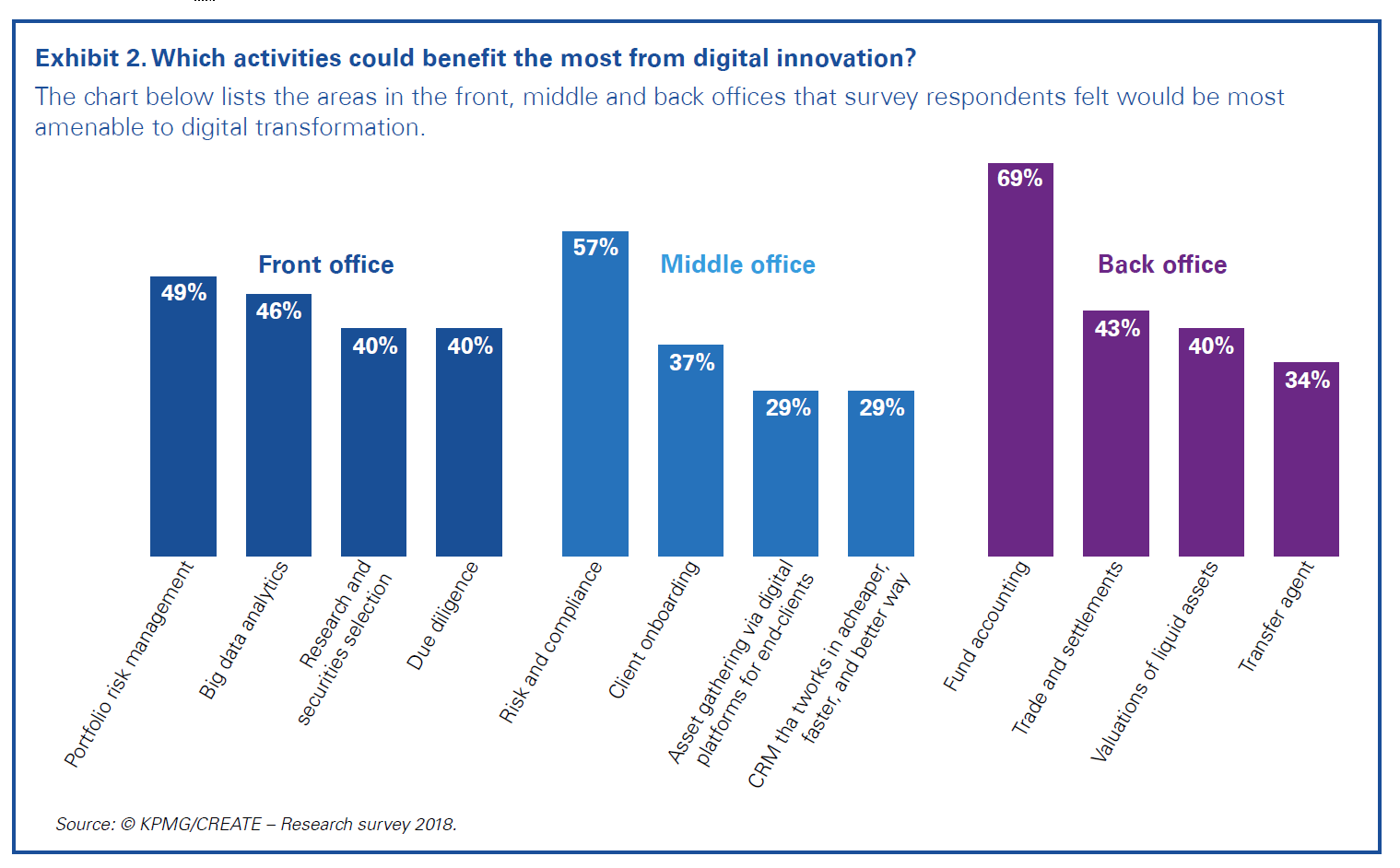
As suggested by KPMG, innovation should not be limited to the front office and the investing process in general, but instead should be spread out across the front, middle, and the back office as the chart below depicts.
This backs up the point we made earlier that potential investors are also very interested in cost containment and want to see evidence that the funds are using technology to make their operations as cost effective and efficient as possible.
Private equity firms are applying technologies to the onboarding of new portfolio companies, which makes the processing of the portfolio company’s financials more efficient and antiquates a manually intensive process that was often subject to data entry errors.
The Hedge Fund Story
A survey by EY reveals that the most innovative hedge funds have already been delving into artificial intelligence and big data for some time now.
“Artificial intelligence and machine learning are more often being used by managers across asset classes and investment strategies to make actual investment decisions. Automation of various facets of the investment process is being embraced, and managers who are able to complement their operations with these tools are gaining significant competitive advantages.” 2
The impact of artificial intelligence on front-office models is significant
In the past year, we saw 300% growth in the use of artificial intelligence (AI) in the front office among hedge fund managers and 100% growth in the proportion that expect to use AI in the near future. Quantitative managers have been on the forefront of this technology for years, but managers of all strategies have been building capabilities and taking advantage of next generation trading systems and tools.
Hedge funds have embraced these capabilities more quickly as their investment strategy of analyzing large volumes of securities and economic data lends itself more to leveraging software and machine learning as part of the trade analysis and execution process. Further, hedge fund managers are more likely to have been further along on the technology continuum. Over their life cycle, most were able to forgo basic tools such as spreadsheets Excel and have been using off-the-shelf and proprietary technology.
Use of big data continues to proliferate
The majority of hedge funds either use or are evaluating “next-gen” data for use cases in their investing — a material increase from two years ago. During 2018, only 30% of hedge fund managers did not expect to use next-gen data in their investment process, a decline from almost 50% who made that statement just two years ago. The explosion in the volume of data that is available and the number of market participants utilizing it have begun to change how many hedge funds think of this information. For many firms in the industry, what next-gen data was a few years ago is now just data.
As a consulting firm with very deep expertise in ERP systems and business expertise in fund accounting and other back office areas, we have been helping our clients from our inception to implement the latest applications and technologies to automate manual, recurring and error prone processes.
The speed at which new technologies have been introduced and adopted by the hedge fund industry in just the past two to three years has been astounding. This is in no small part due to key players like Workday who have begun to dominate the ERP / Financials marketplace with a SAAS-based solution that many hedge funds are implementing.
Now that Workday and other vendors are linking their applications to AI offerings, the cost and effort required for even small fund managers to leverage these technologies in areas of their business other than the front office is even more compelling. This is further backed up by the EY survey:
Hedge fund managers lead in using robotics and AI in the middle and back office.
There has been significant growth in the proportion of hedge fund managers that leverage robotics to perform routine, repetitive tasks in the middle and back office. In 2017, just 10% of hedge fund managers reported that they had invest in robotics or AI. This year a third of hedge managers have implemented robotics and 1 in 10 is utilizing AI.
The benefits are significant. Technology is able to confirm trades, reconcile positions, automate regulatory reporting filings, etc. Once implemented, the tools can work continuously and limit the amount of manual, low-value work performed by people at the manager, freeing these individuals up to perform more value-add activities. The tools and technology are no longer the “wave of the future” so much as the current reality and one of the most impactful means in which managers can scale their operations to support growth and product diversification.
A Warning to Laggard Private Equity Managers
The EY study found some alarming observations in the likelihood of PE funds embracing these new technologies overall. Given the historical use of systems by PE funds, this is not surprising. However, given the increased competition for investors it is shocking that most PE funds seem determined to keep their heads stuck in the sand when it comes to AI.
74% of private equity managers do not expect to use AI. But only 40% of hedge fund managers still hold that expectation.
Conclusion
It seems clear that despite many experiencing weaker performance over the past year, there is only one option for any fund who wants to continue to not only survive, but thrive in the ever more competitive alternative asset management marketplace.
The evidence we have provided in this analysis compels managers to avoid any hesitation on moving forward with key strategic projects. Doing so will inevitably position them at a distinct disadvantage compared to other funds who will be only too happy to take their investors.
Investors are far more savvy and demanding than ever in our industry’s history, and that trend shows no signs of abatement. In fact, we expect that the demands for funds to be more transparent and efficient through technological innovations will only grow exponentially as the 4th industrial revolution takes hold.
Size is no longer a guarantee of leadership in the future, as our historical analysis has shown. It is quite easy to go from a leader to a laggard in increasingly shorter periods of time as the speed of innovation outpaces companies’ ability to adapt.
The words of Klaus Schwab should be a constant reminder to innovate at all costs:
“It used to be that the big used to eat the small, now it is the fast eat the slow and I’m seeing it everyday.”
[1] Innovating During A Recession, By Scott D. Anthony and Leslie Feinzaig, July 8, 2008
https://www.forbes.com/2008/07/08/recession-innovation-retailing_leadership_clayton_in_sa_0708claytonchristensen_inl.html#3b48f53d4757
[2] Article McKinsey Quarterly March 2009 High tech: Finding opportunity in the downturn, By Andrew Cheung, Eric Kutcher, and Dilip Wagle
https://www.mckinsey.com/business-functions/organization/our-insights/high-tech-finding-opportunity-in-the-downturn
[3] At the tipping point: Disruption and the pace of change in the alternative asset management industry, 2018 Global Alternative Fund Survey
https://www.ey.com/us/en/industries/financial-services/asset-management/ey-2018-global-alternative-fund-survey
[4] The Digital Transformation Imperative – Why Private Equity Firms Must Digitally Transform to Compete, By Gavin Geminder, and Jeff Kollin
https://assets.kpmg/content/dam/kpmg/us/pdf/2018/05/737580-nss-pe-digital-transformation-whitepaper-v18.pdf
About FinServ Consulting
FinServ Consulting is an independent experienced provider of business consulting, systems development, and integration services to alternative asset managers, global banks and their service providers. Founded in 2005, FinServ delivers customized world-class business and IT consulting services for the front, middle and back office, providing managers with optimal and first-class operating environments to support all investment styles and future asset growth. The FinServ team brings a wealth of experience from working with the largest and most complex asset management firms and global banks in the world.
FinServ can help you plan for and optimally implement a long term strategy and roadmap to embrace the new technologies of the 4th Industrial Revolution.
Here Comes Flow Builder in Salesforce Spring 2019 – What You Need to Know
In the Spring ’19 Release of Salesforce, Flow Builder will be replacing Cloud Flow Designer. On the surface, this may seem like a minor change, but it has major implications. Here are some key changes that you need to be aware of if you use any Flows in Salesforce.
Flow Designer Brings a Major Change to Salesforce Process Automation
Salesforce is providing a new default application for workflow automation called Flow Builder. Similar to many other Lightning tools, this new component has the promise of a far superior User Interface (“UI”) and a user-friendly and familiar canvas approach (very similar to Lightning page designer). The new tool certainly provides a much more modern and user-friendly look and feel, but the rest of this new tool has a long way to go in terms of delivering on some key items that Salesforce has been promising for workflow automation. In this article we will explore the pros and cons of the current version of the tool and provide a recommendation for any organization that uses or plans to use workflow automation in Salesforce.
(The same Flow side by side – On the left is the old Cloud Flow Designer, On the right is the new Lightning Flow Builder)

A Familiar User Interface
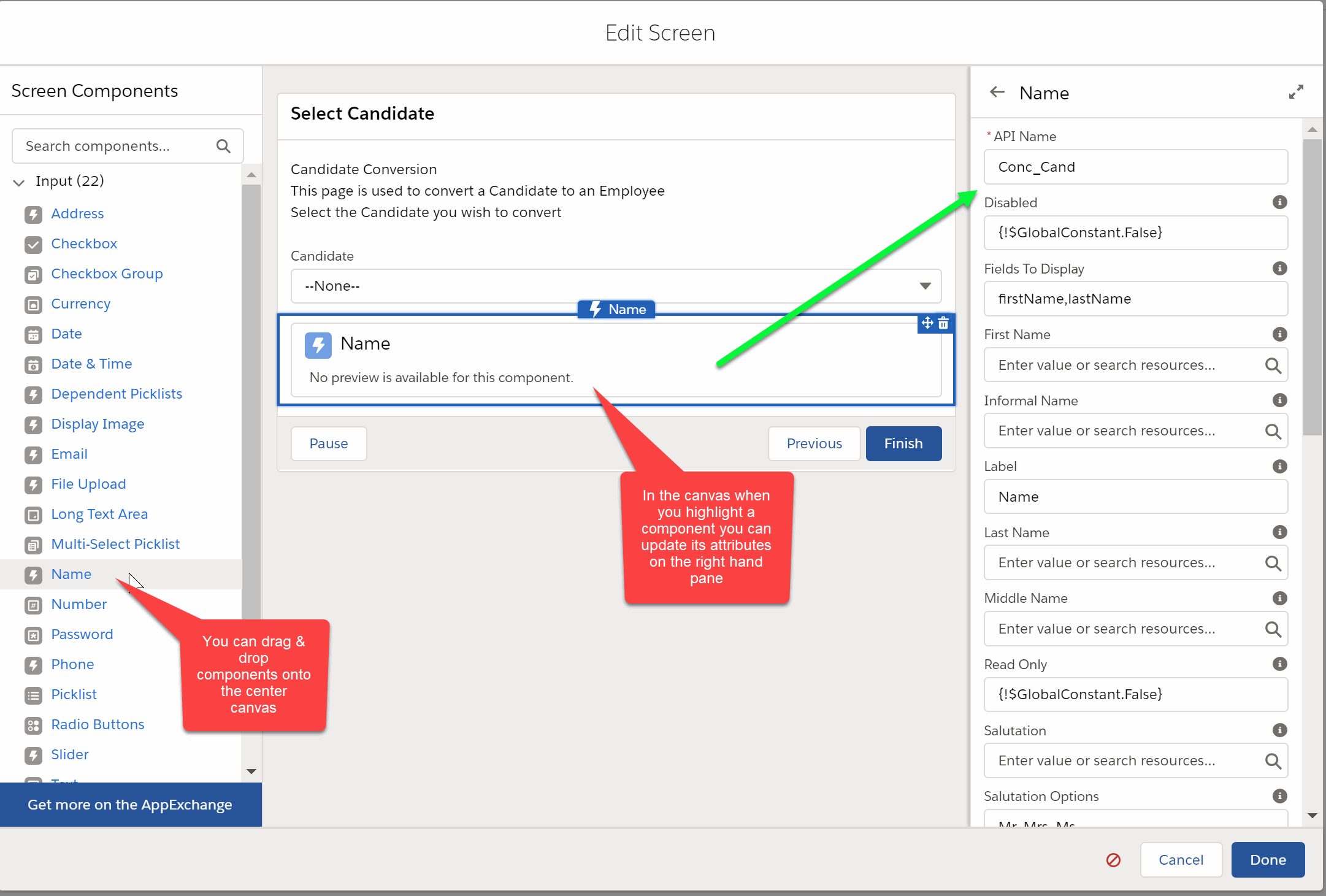
As we noted in the intro, Salesforce has done a great job of providing the very familiar UI canvas, with the components on the left-side panel and the properties on the right-side panel. Certainly, this consistent approach to how Salesforce’s Lightning tools work will make it easy for people creating the flows to quickly adapt to the new tool.
(The new user-friendly Flow Builder Canvas)
Uses of Flow
Workflow automation in Salesforce isn’t new, and people who have been using Salesforce Flows know it is an incredibly useful tool. At FinServ, we have used previous iterations of the Salesforce Flow tools for the automation of key approval processes, such as travel expenses. We have also used Flow to kick off key Conversions of Job Candidates to Employees in our Salesforce Recruiting system and Converting Opportunities to Projects in our Sales Pipeline.
In all these instances, we use the Flow tool to make interaction and updates to key fields, related lists, and attachments to Salesforce Objects highly efficient and more user-friendly, ensuring our team provides all the critical data that our firm needs to act on. Since incomplete data and users providing insufficient information is one of the biggest challenges our clients often ask us to solve, we believe tools like Salesforce Flows are a big part of the answer to having better data. In a world where data is becoming an increasingly important aspect of all businesses, particularly with machine learning and artificial intelligence, it is critical to make it as easy as possible for your users to provide the best data possible.
With Flow Builder, Salesforce is promising to make certain commonly used Flow functions far more efficient. For instance, with the addition of the Phone data type, the validation and masks for a phone number are now built into the properties of the data type so that you no longer need to create your own extensive validation scripts, custom masks, or formatting—which is a huge time saver. Salesforce has also added the Address data type which now consolidates the street, city, state, and postal code components of any address into one streamlined data type.
What Big Issues Exist in the New Tool
It feels like Salesforce is rushing out the new Flow Builder. Overall, the application seems a bit half-baked in our opinion. Our opinion is in large part due to the fact that certain basic tools are missing from this first version of Flow Builder:
- Support for Rich Text Editing – Yes, this is correct and not a typo. The Rich Text Editor that existed in the old Cloud Flow Designer does not exist in Flow Builder. In fact, look at the screenshot below to see how messy your Rich Text will appear in the new Flow Builder. This is because they left support for Rich Text by allowing HTML tags. This is the main reason why I am saying this was rushed. It just does not seem like a commercially viable product with such an open issue.
- No Ability to Copy & Paste – Yes, again this is not a typo. The tool does not support Copy / Paste and Undo / Redo functions that exist in the core tool. Again, it is hard to believe Salesforce would release a tool without what everyone now feels is the most core, basic capabilities any tool has to have.
One of the best features is really the elimination of a huge dependency on Adobe Flash (which is going away by the end of 2020). We suspect this is the main reason why Salesforce is rushing this new tool out.
(Below shows what use of Rich Text in the previous version looks like in the new Flow Builder – an HTML mess!)

What’s New / The Benefits of the Flow Builder
So this new tool is not all bad; in fact, it offers some new and incredibly powerful capabilities. Most exciting are some really powerful data types that people have been looking forward to for a long time, such as:
- Address – Consolidates the different components of any address
- Display Image – Easy way to work with image types
- Email – A mask that is set up to auto-validate and accept email addresses
- File Upload – A built-in way to upload files and link to your Salesforce objects
- Name – Pre-built data type to work with the Contact Object
- Phone – A mask that is set up to auto-validate and accept phone numbers
A Whole New Way to Test your Flows
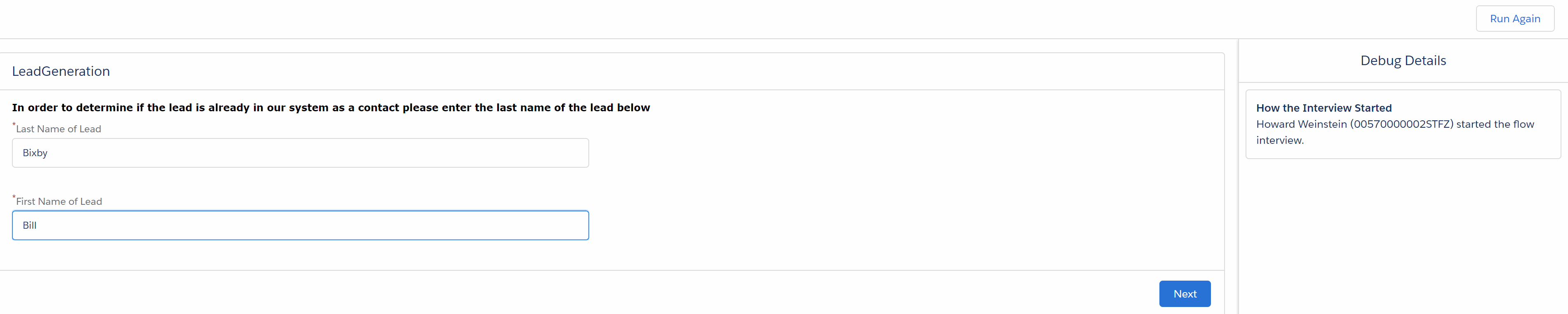
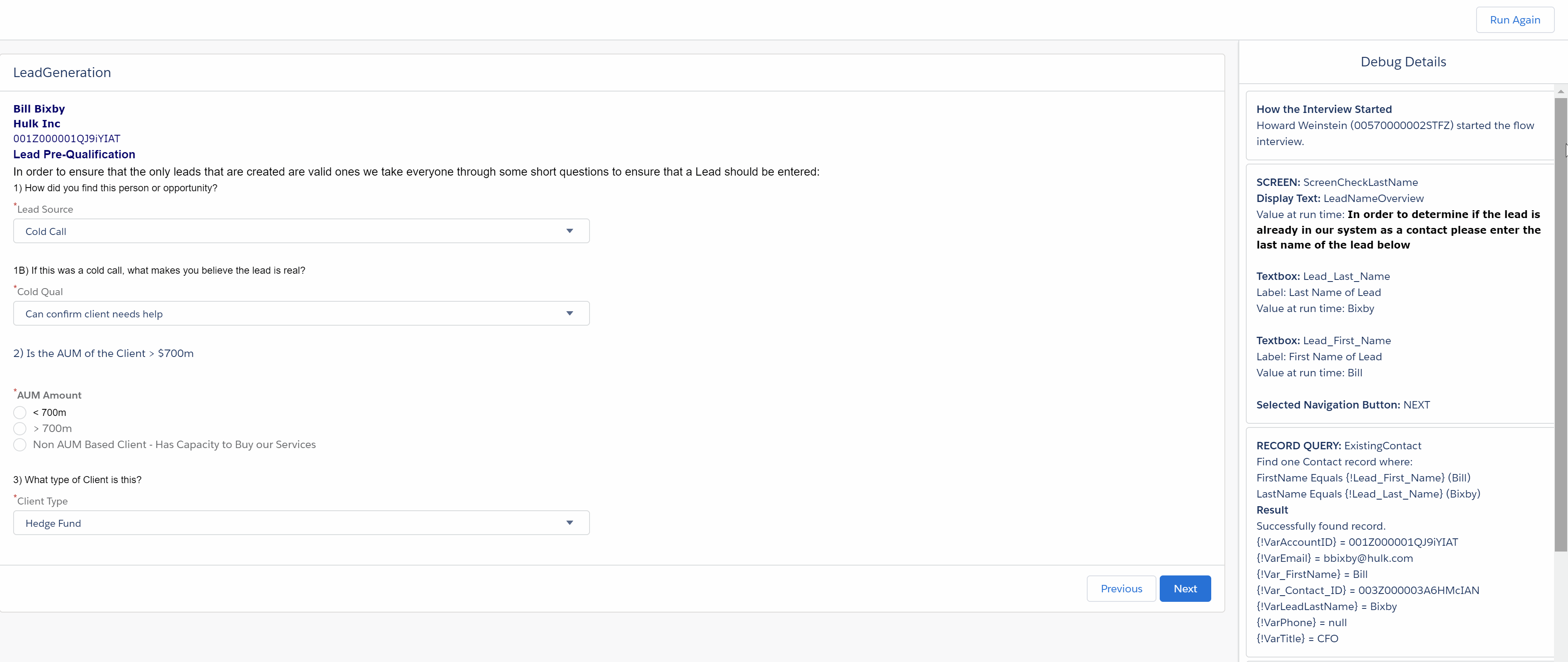
One of the best innovations in the Flow Builder is the addition of a Debugging Tool that allows you to trace through the progression of your Flow as you make entries into your forms. This is especially handy in flows where you may have created multiple decision points, or where you may have created complex formulas to calculate or assign certain values to fields in your objects. Previously, you more or less had to guess how this was occurring. Now with the debugger, you get an amazingly detailed screen on the right-hand side that tells you what element in the flow has executed and the reason why, and also shows you the value of each of your variables in that step.
(Sample screens of the new Debugger Screens to support testing your flows)
Other Benefits
The Flow Builder has also streamlined some of the Data Elements which were very confusing. There is no longer a need to pick between things like a Record Lookup or a Fast Lookup, as these have been combined so that the system will handle it for you. A summary of these related updates is below:
Data Elements
- Record Lookup / Fast Lookup = Get Records
- Record Create / Fast Create = Create Records
- Record Update / Fast Update = Update Records
- Record Delete / Fast Delete = Delete Records
Resources
- sObject data type = Record
- Dynamic Record Choice = Record Choice Set
- Picklist Choice = Picklist Choice Set
Variables
- sObject Variable = Variable, where Data Type is set to Record
- Collection Variable = Variable, where Allow multiple values is selected
- sObject Collection Variable = Variable, where Data Type is set to Record and Allow multiple values is selected
Actions – reduced to just Action Types
- For example, send an email after contact records are created
- Static Action, such as post to Chatter, submit for Approval, or Send Email = Core Action
- Local Action = Core Action
- Quick Action = Core Action
- Apex = Apex Action
- Apex Plug-In = Apex Action (Legacy) – Going away
Logic
- Wait = Pause
Here’s the Catch and Our Recommendation
As we have highlighted in this post, there are many core items that are missing from this initial version of the Flow Builder tool. Some of these omissions can cause major issues if you update your flows with this new tool.
The good news is that if you do nothing and do not touch your Flows, they will work just as they always have. Even better news is you can still have access to the old Cloud Flow Designer by simply going to Setup->Process Automation->Process Automation Settings and you will find a checkbox that says Disable access to Cloud Flow Designer (this is checked by default) and you can simply uncheck the box to get access to the old Cloud Flow Designer.

After a deep dive on the new tool, we suggest to most users that you not update any of your existing flows with the new Flow Builder.
Instead, we recommend that if you are willing to work with a true beta product, you should create new flows or copies of your current flows to experiment with the new Flow Builder (preferably in your Sandbox environment). Start to assess which of the new features you will incorporate once Salesforce releases a more complete version of the tool.
Longer Term View
The new Flow Builder is the future of Process Automation in Salesforce, and the tool will evolve quickly as we saw with the Lightning Platform to become a very valuable addition to the Salesforce arsenal. Unfortunately, in today’s incarnation we can only recommend that you use it in Sandbox, and plan for the new features that will be added in the Summer ’19 release when we expect most of the major shortfalls will be addressed.
FinServ can help you plan for and optimally implement many of the Lightning based technologies and other Salesforce modules like Marketing Cloud and Einstein Analytics.
To learn more about FinServ Consulting’s services, please contact us at info@finservconsulting.com or (646) 603-3799.
About FinServ Consulting
FinServ Consulting is an independent experienced provider of business consulting, systems development, and integration services to alternative asset managers, global banks and their service providers. Founded in 2005, FinServ delivers customized world-class business and IT consulting services for the front, middle and back office, providing managers with optimal and first-class operating environments to support all investment styles and future asset growth. The FinServ team brings a wealth of experience from working with the largest and most complex asset management firms and global banks in the world.
How to Avoid A Failed Systems Implementation
Most companies are not getting the value for the investment in their applications. Plain and simple. Firms are practically throwing money down the drain by purchasing these expensive platforms and not getting the bang for their buck. A fully configured application should be able to provide your firm with increased efficiency, reductions in cost, and provide overall scalability.
However, if you are not gaining these benefits from your software, it’s time to take a step back. A failed implementation could cause the opposite of the desired outcomes. This under-utilization can be due to:
- A weak support system in place for the maintenance of the software
- Lack of communication to the employees of the software’s full functionality
- Lack of proper employee training in the application
Having the right support model in place to oversee the setup and continued maintenance of the application can help insure that the platform is properly aligned with your firm’s daily operations and all updates are made regularly to avoid lag or error.
Establishing a communication plan within the firm for internal resources to fully develop an understanding of what the application is capable of creates a baseline for what the expectation is from the platform, and how it could best be used to meet the client’s goals. Identifying the right material requirements to develop a robust platform to best fit your firm’s needs requires personnel that truly understand the software’s usability and functionality.
Having a team dedicated to software training creates a sense of ownership for the system, as this team can communicate to other members of the firm the immense capacity for automation across different functional areas which they can train other firm members in. Openly communicating the status of the platform’s setup and capabilities also reduces the risk of functional teams working in silos.
FinServ has had experience with high-growth clients going through similar pain points during the implementation of an systems to automate their day to day operations. We take a comprehensive approach in order to understand your bespoke business processes to help guide your firm towards a seamless software integration and ultimately, future success.
To learn more about FinServ Consulting’s services, please contact us at info@www.finservconsulting.com or (646) 603-3799.
About FinServ Consulting
FinServ Consulting is an independent experienced provider of business consulting, systems development, and integration services to alternative asset managers, global banks and their service providers. Founded in 2005, FinServ delivers customized world-class business and IT consulting services for the front, middle and back office, providing managers with optimal and first-class operating environments to support all investment styles and future asset growth. The FinServ team brings a wealth of experience from working with the largest and most complex asset management firms and global banks in the world.
What to Expect When You’re Expecting… a Workday Financials Implementation
Getting Started
After a long selection process, your company decided to go with Workday Financials. You have been sold on the “power of one” and are really looking forward to re-designing your financial processes and finally having a good answer for your auditors. The pre-sales teams have come in and have demonstrated solutions to your current problems. But now the realization sets in….This is going to be a lot of work!
Hopefully, your company has also spent time selecting the right integration partner and have augmented their staff with dedicated internal and external project individuals. A critical first step, is an internal one, spend time thinking about how you want the process to look or what reports you want to produce. This will allow your firm to answer important questions from Workday or the integration partner more effectively.
Workday Methodology
Workday has a formalized methodology and whether your integration partner is Workday themselves or a certified partner, you will find the process to be regimented. The first step in the process is called the Foundation Alignment Sessions (“FAS”). You will be given workbooks to populate which detail your current process. Workday, or the integration partner will ask questions to guide you on how you want this information to be stored in Workday. It is important to note, that a process review is not part of this process. Changes to future processes will be based on decisions made outside of alignment sessions. During the sessions, you may be asked questions to which you don’t know the answer. You may also answer questions having not fully understood the ramifications of the decision. That said, there is still time at this point to re-visit these decisions.
The FAS will cover everything from financial accounting, budgets, expenses, customers, suppliers, banking and any other process or “SKU” that was purchased from Workday. Every session will focus on a business process which is the approval flow associated with the transaction, as well as the key worktags that will need to be populated.
Upon completion of the FAS, the integration partner will conduct a walkthrough of the Workday environment in what is called customer confirmation sessions. This is a chance to fine tune the configuration and make additional decisions.
Testing
After these sessions, the configuration team will update the system and deliver a unit test tenant, at which time, you will be responsible for producing unit test scripts. Upon successful completion of the unit tests (and subsequent updates to the configuration), there will be user acceptance testing (which essentially strings together unit tests) and data conversion. These efforts can be time consuming and should not be underestimated.
A separate wortkstream is needed for managing interfaces (called integrations) and could be with banks or other third-party applications. Additionally, IT is typically involved in SSO and potentially user roles and security. Communication, training and hand holding can be expected.
Go-Live
Your original assessment that this will be a lot of work turned out to be true. However, what you can expect is a powerful platform capable of detailed and flexible analytics to support both your financial and management reporting requirements. Many processes that took you hours or days will be reduced to seconds or minutes. The user community will be capable of self service, which will free up your time to do more value-added activities. Most importantly, the information will be consistent, accurate and necessitate less time with auditors and regulators.FinServ Consulting has been providing technology and business solutions to financial services firms for over 15 years.
For more information on how we can help or guide your strategic direction, please contact us at info@finservconsulting.com or 646-603-3799.
About FinServ Consulting
FinServ Consulting is an independent experienced provider of business consulting, systems development, and integration services to alternative asset managers, global banks and their service providers. Founded in 2005, FinServ delivers customized world-class business and IT consulting services for the front, middle and back office, providing managers with optimal and first-class operating environments to support all investment styles and future asset growth. The FinServ team brings a wealth of experience from working with the largest and most complex asset management firms and global banks in the world.
How to Prepare for Workday’s Upcoming Semiannual Release
It’s a new year and Workday’s Semiannual Release is fast upon us. As always we recommend thoroughly reviewing the Announcing and Feature Consideration documentation and review the notes in the Release Center prior to the release date, March 9th, 2019. With new features available in Preview Tenants starting on February 2nd, your team can get a jump start on reviewing and testing the new release features to ensure there are no major impacts to your tenant. Here are a few tips that have served us well with past clients:
- Prioritize the features. The first action we recommend customers take is to review all the release features and prioritize which items are High or Low impact. It’s important to identify which updates may directly impact your tenant or indirectly impact other systems. Use the tools Workday provides, they offer a spreadsheet that categories each new release feature. It’s a quick and easy way to understand all the release features. In this semiannual release the Workday Inbox worklet is being retired and there are new updates for Payroll integrations. We’d label the Workday Inbox worklet as Low Impact since the Inbox now is featured directly on the Home screen. For those clients with a third party payroll system, the Payroll integration updates could be a High Impact so it’s important to review the release notes and thoroughly test.
- Adjust your project plan. In a previous post we wrote about the importance of creating an annual Workday project plan. Once you’ve identified how the release will impact your tenant, make sure to adjust your project plan so that it accounts for the time you’ll spend testing the new features. Ideally, you factored the Release into your Workday project plan but make sure you adjust appropriately if other initiatives need to take a backseat while you prepare for the semiannual release.
- Enlist help. Enlist the help of your team and other users to make sure that you’ve adequately tested the functionality. It’s okay to have one person lead the Semiannual release preparation but we recommend spreading the testing among your Workday team and other employees at the firm. You’ll want to make sure you test every scenario and examine all the details, which is doable with the help of others.
- Communicate to your Super Users. If you’ve identified items that will impact your tenant or new features your team could leverage we recommend getting the word out as soon as possible. In past releases we’ve seen updates to functionality that seem minor, like modifying the way a phone number is entered into Workday, create a lot of noise for your other infrastructure teams.
FinServ has experience advising clients on Workday’s semiannual release, including assessing which features will impact the client’s tenant, recommending new features to adopt, and testing existing functionality and integrations. We also work with clients to plan their annual Workday initiatives, build new functionality, and maintain their system security. To learn more about FinServ Consulting’s services, please contact us at info@www.finservconsulting.com or (646) 603-3799.
About FinServ Consulting
FinServ Consulting is an independent experienced provider of business consulting, systems development, and integration services to alternative asset managers, global banks and their service providers. Founded in 2005, FinServ delivers customized world-class business and IT consulting services for the front, middle and back office, providing managers with optimal and first-class operating environments to support all investment styles and future asset growth. The FinServ team brings a wealth of experience from working with the largest and most complex asset management firms and global banks in the world.
The 4th Industrial Revolution: How FinServ is Helping Clients Take Advantage of the New Tech Paradigm
Coined by Klaus Schwab, the 4th Industrial Revolution promises to develop so quickly that those ahead of the curve today may not be able to keep up with the ripple effect of the changes. At FinServ, we believe it is our job to ensure our clients stay on top of that wave, by providing constant service and insights that take advantage of, the best new technologies.
Why You Should Care About the 4th Industrial Revolution
When we speak to our clients about Industry 4.0, the most common question is, what is it? Why should I care? The term itself does not matter. What does matter is, the name acts as a focal point to enable FinServ to focus our clients on what does really matter.
Whether it is: 1) New technologies embedded in the best industry applications, 2) New agile governance models being put in place, or 3) The core aspects of data privacy that are drastically changing, we believe our client’s need to be ready to adopt and adapt to each of these disruptive forces.
Sears a Cautionary Tale
I was recently watching a piece on how Sears, a company that once was on top of innovation is now going out of business. Each of these anecdotes shows that even the best of funds could end up losing its investors if they do not continue to innovate and take advantage of what technology is offered. There are always hungry new funds, just like Amazon was to Sears that will be more than happy to take your position and your investors if you do not stay on the leading edge.
The Key Challenge
Due to security concerns our industry is a laggard to most new and emerging technologies. While many firms took advantage of the public cloud, a surprisingly high number of our clients are still hesitating to take advantage of this key resource.
We agree with our clients in terms of utilizing the highest standards of protection for their client and investment data, but this should not keep you from adopting technologies in an intelligent manner. It takes extra work and due diligence, but these technologies like public clouds can be safely and securely implemented for any firm. The most critical step is to hire an expert in the technology to ensure it is configured with all the most important safeguards in place.
When you set up a server on Amazon Web Services (“AWS”) you can leave yourself completely open to attack, or you can configure with all the tools AWS provides to be more secure than your own private cloud. It only requires the expertise to know how to complete the configuration.
Speed with Purpose
The terms speed with purpose was something I first came across during my time at KPMG. It was used to describe one of the core values of the firm. I always loved this phrase, because it described something I always believed in, that you should take action and produce outputs and outcomes as quickly as you can. The word purpose added something essential. Purpose highlights that you should not be reckless in your pursuits, and it further suggests that you could act thoughtfully at the same time.
We believe this is exactly how our client base should act towards the technologies and changes that relate to the 4th Industrial Revolution. Our clients should dive into these technologies now, while ensuring that as they implement the changes they are taking the proper precautions, and putting into place the proper controls that will continue to protect their businesses from crucial errors.
Applying the Technologies to our Industry
One key technology Artificial Intelligence (“AI”) is critical to our industry. AI has been a large focus on many funds for several years now.
Whether it be the Investor Relations group using predictive analytics to identify the best investors to pursue, or the front office using prescriptive analytics to draw up specific recommendations in investing you can’t deny the value of these technologies.
Lessons from Data Warehouse Experiences
The biggest barrier to getting on these technologies was the cost and time to set them up. Over the past decade, many clients engaged FinServ in discussions about creating data warehouses. Less than 10% of those clients actually took any real steps to create them, and far fewer ever realized the final goal or benefits.
Thanks to SAAS-based solutions and virtual computing new AI engines are popping up all over the place. These solutions offer a very low-cost entry to powerful AI engines. Microsoft, Salesforce, and SAP just to name a few vendors offering AI platforms that can be acquired and setup in weeks or months.
We strongly suggest before selecting one of these platforms that you do conduct a full vendor selection. Like all system selections ensuring you are picking the right solution that fits your specific requirements is critical. Each of these AI platforms do have their own strengths and weaknesses and aligning those to your business is paramount. As part of this selection process we endorse vetting the security and controls provided by each of these vendors.
One Real World Example
Up to this point we have spoken about why you should adopt new technologies and spoken to most of the reasons firms hesitate to act. Providing an example how a technology today can enhance one common pain point may be the best way to bring people over to adoption.
From the dawn of computerization the dependency of getting users to enter their data into the system has been a large issue. Now with our smartphones we have a device that when combined with AI technology can alleviate that issue. Salesforce introduced Einstein Voice which leverages your voice allowing you to dictate important notes into your smartphone and the AI portion of this solution than intelligently identifies the components of your data and links that to your CRM / sales system as an example to route your information intelligently to those people in your firm who need to act on that data.
Einstein Voice
The Bottom Line
New technologies are arriving at our doorstep with regularity and speed we have never seen before. Knowing which ones to choose and how to safely and effectively implement them can be daunting. You should not let security concerns hold you back from ensuring your fund can compete for investors who are becoming more savvy and discerning about their choices of funds. If anything adopting these new tools will ensure they see you as an innovator worth investing in.
FinServ can help you plan for and implement these technologies in a safe and effective manner with time tested methods and the speed required to have you up and running in the most expedient time possible.
To learn more about FinServ Consulting’s services, please contact us at info@www.finservconsulting.com or (646) 603-3799.
About FinServ Consulting
FinServ Consulting is an independent experienced provider of business consulting, systems development, and integration services to alternative asset managers, global banks and their service providers. Founded in 2005, FinServ delivers customized world-class business and IT consulting services for the front, middle and back office, providing managers with optimal and first-class operating environments to support all investment styles and future asset growth. The FinServ team brings a wealth of experience from working with the largest and most complex asset management firms and global banks in the world.