
Navigating the Complex World of Trade Confirmation and Settlement
In the dynamic environment of financial markets, post-trade processing and trade settlement hold immense significance to investors and
financial institutions. Precision and efficiency are imperative for maintaining smooth operations with transactions unfolding rapidly.
Despite impressive technological strides, human errors endure, casting repercussions across the industry. The shift to T+1 and T+0 settlements has intensified challenges, leaving little room for error.
To successfully address these complex challenges, investment firms are actively searching for trustworthy and reputable partners with in-depth expertise in post-trade execution. These partners have the ability to seamlessly navigate the intricate network of transactions and provide unwavering assurance to clients in their post-trade activities.
This blog explores the intricate landscape of trade confirmation and settlement, unravelling the six pivotal steps underpinning these essential processes. Our aim is to demystify the intricacies and shed light on the crucial stages that culminate in the seamless execution of trades within the financial realm.
| Key Stages | Description | Highlights |
| Order Placement | The trade settlement process is initiated with order placement. Fund managers/ clients convey buy or sell orders to their executing brokers, outlining the security, quantity, price, and other pertinent particulars. | Fund Managers use a variety of different OEMS platforms like Eze, Enfusion, Bloomberg AIM, etc., to initiate orders. |
| Trade Execution | Upon receiving the order, the broker assumes the role of an intermediary and initiates the trade execution process on behalf of the client. This critical phase involves translating the client’s order into actual market transactions, where the broker facilitates the buying or selling of the specified securities. | Trades are executed over the FIX network through platforms like NYFIX, and Bloomberg deployed on the executing broker systems for trade execution and matching. |
| Trade Matching | Trade matching constitutes a pivotal phase within the trade confirmation and settlement framework, characterized by the simultaneous electronic input of trade particulars by two distinct sources into a dedicated electronic trade matching platform. This process derives its nomenclature from its fundamental principle: the parity and equality maintained between both participating parties. The electronic trade matching platform serves as an arena where these trade details are systematically compared and validated. Through a series of automated processes and cross-checks, the platform diligently assesses the submitted particulars for congruence, highlighting any disparities or inconsistencies that require resolution. | Various trade matching platforms such as Omgeo’s CTM, MarkitSERV, Traiana, ICE Link, and BTCA facilitate trade matching by connecting counterparties and streamlining the trade confirmation process. |
| Trade Validation | Trade validation is a crucial process involving a final comprehensive check of gathered information. This validation allows potential issues or discrepancies to be proactively identified and corrected before engaging with other entities. This step ensures that accurate and reliable data is communicated, minimizing the risk of errors in subsequent stages of the trade process. By offering an opportunity for rectification, trade validation contributes to the overall efficiency and integrity of the trading system, instilling confidence in all involved parties. It acts as a safeguard, preventing the propagation of erroneous information and promoting seamless trade execution. | DTCC’s GTR, SWIFT’s Accord, MarkitSERV’s TradeServ are a few trade validation systems in the market that cater to different asset classes and trade types. |
| Trade Confirmation | After reaching a consensus among all involved parties, the trade enters the critical phase of trade confirmation. Here, a formal acknowledgment of the trade’s specific details and agreed-upon terms is exchanged. This includes crucial information, such as settlement instructions. Trade confirmation acts as a binding agreement, solidifying the transaction and establishing the groundwork for subsequent processing steps. This process allows potential discrepancies or misunderstandings to be identified and resolved, ensuring a smooth and transparent trade flow. Ultimately, trade confirmation plays a pivotal role in enhancing the efficiency and reliability of the overall trading process, instilling confidence in all stakeholders, and minimizing risks associated with trade execution. | Trade confirmation is a pivotal stage, signifying successful trade execution among parties. Accurate confirmation is especially crucial due to varied settlement cycles:
|
| Trade Clearing and Settlement | Following trade confirmation, the clearing and settlement process is initiated, facilitated by the clearing house. In this stage, the clearing house assumes the counterparty risk, acting as an intermediary to ensure a seamless settlement of the trade. Validating trade details and calculating net obligations it guarantees the availability of funds and securities necessary for settlement. By undertaking this vital role, the clearing house enhances the security and efficiency of the overall clearing and settlement process. This crucial step mitigates potential risks and minimizes the chances of payment or delivery failures, instilling confidence in market participants and fostering a stable trading environment. | The settlement process involves diverse payment methods based on security type and trading venue:
|
Key Stakeholders in the Trade Settlement Lifecycle
| Stakeholders | Roles |
| Executing Brokers | Brokers act as intermediaries, connecting clients to financial markets. They receive and execute trade orders on clients’ behalf. Brokers also participate in trade affirmation, confirming trade specifics per client preferences before proceeding to settlement. |
| Custodians | Custodians safeguard and hold securities in trust for clients. Crucial to settlement, they ensure securities are available for delivery and assist in resolving discrepancies during trade affirmation. Custodians play a vital role in maintaining accuracy and security. |
| Fund Managers | Clients, as investors, utilize brokers to execute buy or sell orders. Initiating trade confirmation and settlement, clients drive the entire sequence through their trade instructions, playing a pivotal role in the process. |
| Clearing House | The clearinghouse acts as an intermediary between buyers and sellers, ensuring accurate trade settlement. Assuming the buyer role to every seller and vice versa minimizes counterparty risk and guarantees trades. This mechanism enhances market stability and safeguards the trading process. |
Navigating Trade Settlement Complexities
Although the trade settlement process aims for efficiency, its complexity arises from various factors. Let’s delve into some of these intricacies and examine why clients frequently rely on external institutions (such as custodian banks and clearinghouses) for assistance in trade settlement:
- Regulatory requirements: Different geographical regions and financial markets adhere to distinct regulatory frameworks for trade settlement. Complying with these regulations adds intricacies that require specialized expertise to navigate effectively.
- International transactions: Cross-border deals introduce additional complexities related to foreign exchange dynamics, tax implications, and adherence to global legal regulations.
- Trade volume and frequency: Institutional investors and traders often handle a high volume of trades. Managing settlement for such a large volume of transactions can be time-consuming and prone to errors.
- Trade types and instruments: Financial markets host a variety of trade types and instruments, including equities, bonds, derivatives, and more. Each instrument’s settlement process possesses unique characteristics, contributing to overall complexities.
- Time sensitivity: Timely settlements are crucial to prevent trade failures or penalties. Ensuring all parties meet deadlines requires efficient communication and execution.
- Risk management: Trade settlement involves counterparty, operational, and market risks. Inadequate risk management could lead to financial losses.
In response to these challenges, investment firms are actively seeking reliable and proficient partners who can confidently manage post-trade execution activities. This is where expert consulting firms come to the forefront, offering comprehensive trade settlement services tailored to the unique requirements of investment firms.
These firms understand the pivotal nature of the settlement process and the financial and reputational consequences of errors. With a team of experienced professionals, cutting-edge technology, and a profound grasp of the financial sector, these firms are well-prepared to handle the complexities and intricacies of trade settlement. Through meticulous attention to detail and stringent quality control, they ensure accurate and efficient processing of each trade, mitigating the risk of errors and reducing potential losses for clients.
| How FinServ Transformed Client Operations: A Short Case Study |
|
In a recent collaboration, FinServ Consulting showcased its commitment to tailoring solutions for a client grappling with extensive trading activities in the APAC markets. Challenge: The client’s struggle with limited local support prompted a custom approach to enhance operations and streamline trade support. Solution: Understanding the client’s precise needs was vital. This led to devising tailored trade support solutions. Documenting the trade settlement process with clear procedures, timelines, and responsibilities established a transparent and structured framework. Our team executed the trade settlement process meticulously per the client’s instructions, swiftly resolving any discrepancies that emerged. During market volatility, vigilant trade monitoring was prioritized to protect the client’s interests from potential adversities. A robust communication channel was established to address crucial concerns promptly. Consistent updates on trade status fostered client reassurance and confidence in our services. Result: This engagement exemplified FinServ Consulting’s client-centric dedication. Personalization, understanding, and transparent communication culminated in empowering the client to navigate APAC market challenges confidently. |
Conclusion:
Trade settlement facilitators play a pivotal role in aiding clients with their trade settlement needs. These facilitators offer an array of services aimed at streamlining and speeding up executing and finalizing trade transactions. Their services typically encompass trade matching, clearance, and settlement. Harnessing cutting-edge technologies and established networks guarantees accuracy, transparency, and security in trade settlements. Clients reap the benefits of minimized operational risks and expedited error-free settlement cycles. Moreover, these facilitators provide valuable insights and reporting, empowering clients to make informed decisions and optimize their trade activities.
About FinServ’s Middle & Back-Office Services:
Organizations must leverage tailored solutions to meet their unique requirements in the fast-paced and competitive financial services industry. FinServ Consulting stands out as a trusted partner, offering a comprehensive solution suite that empowers portfolio managers, operations teams, and back-office functions. By aligning technology with industry best practices, FinServ Consulting helps organizations drive efficiency, enhance decision-making, and deliver value across the board. Embrace the power of tailored financial services solutions with FinServ Consulting and unlock your organization’s potential.
To learn more about FinServ Consulting’s services, please contact us at info@finservconsulting.com or (646) 603-3799.

HCM for Asset Managers: Find the Right Solution for Your Firm
An HCM solution is an integrated system that automates HR functions combined with finance, planning, and analytics and allows for employee self-service capabilities, thereby reducing labor costs, optimizing business processes, and increasing efficiency. Companies that transition from manual processes and disparate legacy systems to modern, cohesive digital workforce management technologies can realize up to 15-25% cost savings related to HR and IT spend.
Most current HCM solutions are offered as a cloud-based, SaaS delivery model and include modules for payroll, HR, time and labor management, and recruitment. This type of solution does not require an expensive hardware investment and constantly updates software to the latest version while maintaining secure backups. These systems are monitored at all times and provide the utmost reliability. An added plus for asset managers is that the solutions can be customized to suit the size of any company and grow as the organization grows.
At FinServ Consulting, we have experience working with firms of various sizes in the alternative asset management industry to select, implement, and/or upgrade their HCM systems. While there are numerous benefits of having one comprehensive, integrated HCM, there are other options available on the market such as lite solutions that meet basic needs without all the added features that may not be necessary for some firms, as well as point solutions that cater to the industry’s unique needs, like complicated compensation structures. FinServ can help assess your company’s specific requirements to identify what to be aware of in terms of missing features, implementation issues, and cost-benefit analysis of different HCM options.
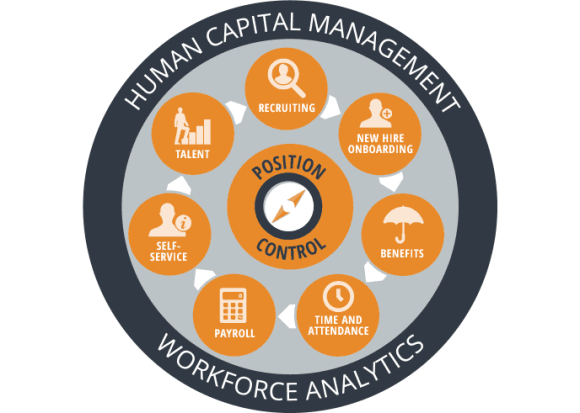
Benefits of a Consolidated HCM
Attract and Grow Talent
Recruiting top talent and keeping them engaged is no longer just HR’s responsibility—talent objectives can have a significant financial impact on growing a financial services business. Implementing a new HCM system can help enhance performance management processes to eliminate bureaucracy and encourage meaningful conversations between managers and employees focused on performance improvement. In addition, better compensation data and visibility of top talent allow managers to make more well-informed decisions regarding performance and rewards.
Some clients in the alternative asset management space that FinServ has previously worked with used manual spreadsheets to manage staff performance, as well as recruiting and other functions in some cases. However, by opting for a consolidated HCM system, these organizations were able to use more sophisticated workflows to provide employees with more meaningful feedback. Also, they could track and monitor operational outcomes and staff development across the company to ensure a payback from their HCM investment.
Make Better Informed Decisions
Asset management firms in the current environment face increasing regulatory scrutiny, such as GDPR, AIFMD, and Form PF, and constantly evolving standards. In order to meet the new generation of demands, these companies need to make well-informed investment decisions with visibility into all business lines. However, this is a difficult task when the data required to deliver these insights is housed in disparate legacy systems with varying formats and level of detail. This is where having consolidated HCM comes in—a single system for finance, HR, planning, and analytics can offer the necessary foundation to gain better insights, save time on data aggregation, and proactively solve business problems. A digital solution of this type can help improve business margins, provide competitive differentiation, attract and retain customers, and identify lucrative areas for growth.
Harness the Power of Modern Data
Today’s financial companies have an unprecedented amount of valuable data across their organization. However, many are still not able to access this data due to isolated, unorganized, and inaccurate legacy systems. The data warehouses that are typically accessed by business intelligence tools to create reports or perform financial analyses hold data that was accurate at the time it was loaded and refreshed from legacy systems, resulting in a high likelihood that it is out-of-date and unreliable. As a result, financial services firms often turn to add-on custom software solutions to try and achieve real-time data extraction, but these products often produce further challenges because they require continuous maintenance to keep up with the changing needs of the business.
Implementing a contemporary, consolidated HCM system allows firms nimble access to the real-time data that is necessary for constantly changing business needs. These solutions include technologies, such as cloud computing, open APIs, artificial intelligence, and machine learning, that make insights transparent and accessible across lines of business.
Build Organizational Agility
Being agile is key to an asset manager’s long-term success and there are several factors at play in building organizational agility:
- Adaptable: A flexible technology foundation is essential to be able to change organizational structures and processes in response to regularly shifting business needs.
- Skilled: Financial services firms, among others, face a widening skill gap and must find ways to upskill their workforce.
- Empowered: In order to perform at the highest potential to meet evolving consumer expectations and drive success, employees need full access to data to make business decisions.
- In Control: The need for measurement and control goes hand in hand with agility and speed. Asset managers must measure more relevant KPIs to learn from what works and what doesn’t when it comes to new digital revenue streams.
There are common obstacles that firms must overcome to meet the guidelines above, including inflexible legacy technologies, bureaucratic organizational culture, and a lack of relevant employee skills. By using a comprehensive HCM solution to add intelligence to business tasks, financial firms can move past these challenges and employ integrated, real-time planning in order to build organizational agility and realize their digital growth aspirations.
Choose the Right Solution
As mentioned previously, there are many HCM offerings available on the market and it is important to select the right one to meet your firm’s unique needs. There are several factors to consider, such as the needs and priorities of the business, size of the firm, and desired metrics and reporting abilities. FinServ Consulting has experience working with asset management firms to identify and implement a suitable HCM solution. We can help you make the right decision and take full advantage of the capabilities and rewards that the new solution will provide.
Summary
If you are interested in establishing or improving your firm’s HCM platform, FinServ Consulting is the right partner to help you reach your firm’s strategic objectives. Throughout our 15 years of existence, we have proven that our deep industry knowledge combined with our project management and overall best practice methodologies can be an asset to your organization. To further continue the conversation or to discuss more of FinServ’s capabilities, please contact us at info@finservconsulting.com or give us a call at (646) 603-3799.
About FinServ Consulting
FinServ Consulting is an independent experienced provider of business consulting, systems development, and integration services to alternative asset managers, global banks and their service providers. Founded in 2005, FinServ delivers customized world-class business and IT consulting services for the front, middle and back office, providing managers with optimal and first-class operating environments to support all investment styles and future asset growth. The FinServ team brings a wealth of experience from working with the largest and most complex asset management firms and global banks in the world.