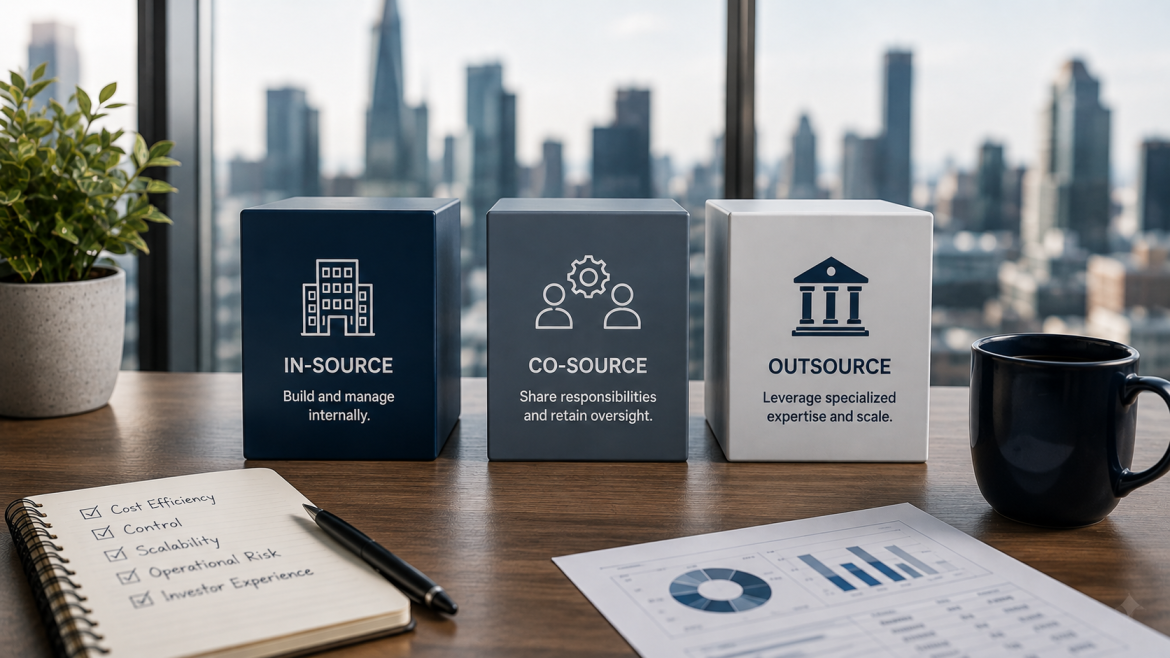
Every alternative investment manager eventually has to decide who actually performs fund administration, and while in-sourcing, co-sourcing, and outsourcing can each be right for the right firm at the right stage, the choice deserves to be made deliberately rather than by default.
Every private equity, private credit, and alternative investment manager eventually confronts the same question about its back office: who should actually perform the work of fund administration? Someone has to strike net asset value, maintain the books and records, process capital calls and distributions, produce investor statements, and keep pace with a lengthening list of regulatory, tax, and audit requirements. The question is rarely whether this work gets done, as it must be completed, but rather who does it, and under what operating model.
There are three broad answers. A firm can in-source, building and running administration with its own people and technology. It can outsource, handing the function to a specialist third-party administrator. Or it can co-source, dividing the work between an internal team and an external provider. Each of these models can be the right choice for the right firm at the right stage, and each carries a distinct profile of tradeoffs across cost, control, scalability, and operational risk.
What follows is a practical look at all three. We review what each model is, where it tends to work well, and where it tends to create friction. We will provide our FinServ Consulting perspective on how firms can approach the decision, and adjust course when a model no longer fits.
In-Sourcing: Owning the Function End to End
In-sourcing means the firm performs fund administration internally. The manager employs its own fund accountants and operations professionals, licenses or builds its own accounting and reporting technology, and retains full ownership of the processes that produce NAVs, investor reporting, and financial statements. Nothing of substance is delegated to an outside party; the general partner’s own team is accountable for the entire administrative workflow.
The principal advantage is control. When administration lives in-house, the firm decides how work gets done, how quickly issues are resolved, and how reporting is tailored to the preferences of its investors and its investment team. Institutional knowledge stays within the firm’s walls, and proprietary data never leaves them. This is a meaningful consideration for managers with sensitive strategies or particular views on data security. Response times can be fast because the people doing the work sit alongside the people who need the answers, with no external service-level agreement to negotiate. For the largest managers, a well-built internal platform can even become a competitive advantage in its own right.
The tradeoffs are equally clear. In-sourcing carries a substantial fixed-cost base: salaries, benefits, technology licenses, and infrastructure that must be funded regardless of market conditions. Building and maintaining modern administration technology requires sustained capital investment and specialized talent that is expensive to attract and difficult to retain. The full weight of regulatory compliance and audit support falls on the internal team. In-sourcing also concentrates operational risk within a single group, so a stretch of turnover or a system failure has few external buffers to absorb the impact. And because the model does not scale easily, launching a new fund, entering a new strategy, or expanding into a new jurisdiction can quickly outstrip the capacity of an in-house group sized for a simpler firm.
Co-Sourcing: A Shared Operating Model
Co-sourcing sits between the other two models. The firm retains an internal administration team while also engaging a third-party administrator, and the two share the work. In many arrangements, the external provider operates the firm’s core fund-accounting platform and performs day-to-day processing, while the internal team supervises, reviews, handles complex judgment calls, and owns the relationship with investors and auditors. The model can also take other forms, including running the firm’s operations on the administrator’s technology while keeping its people in-house, or embedding administrator staff who work alongside the firm’s own team and systems.
Co-sourcing is designed to capture the best of both worlds. The firm gains access to its choice of technology and processing capacity without surrendering internal expertise or day-to-day oversight. A capable internal team can act as a quality-control layer, catching issues before they reach investors and preserving institutional knowledge within the firm. The model offers flexibility, too: reporting and workflows can be customized more readily than in a fully outsourced arrangement, and the firm keeps a direct hand with the functions that matter most to its investors.
The same structure that makes co-sourcing attractive can also make it difficult to run. Because the firm maintains an internal team and pays administrative fees, it incurs dual overhead, and if the internal team is small, it may provide neither full redundancy nor decisive control. Accountability can blur at the seam between the two groups: when an error occurs, ownership is not always obvious and resolving it can require untangling who was responsible for what. Technology and data can sit across two environments, creating reconciliation and integration work. And a lean internal team introduces key-person risk, where the departure of one or two people can destabilize the whole arrangement. Co-sourcing rewards active governance of the internal–external relationship; where that governance is weak, the model tends to underperform.
Outsourcing: Delegating to a Specialist
Outsourcing places the administration function with a specialist third-party administrator that performs the work on the firm’s behalf. The provider strikes NAVs, maintains books and records, produces investor reporting, and typically supports audit and regulatory requirements, operating on its own technology platform with its own staff. The general partner retains oversight and ultimate accountability to investors, but the administrator handles operational execution.
Outsourcing converts a largely fixed cost into a variable one that scales with assets rather than headcount, which is why it is often attractive to firms that expect to grow or prefer not to build infrastructure. It provides access to institutional-grade technology, investor portals, and reporting capabilities that would be costly to replicate internally. A reputable administrator brings a single point of accountability, established controls and attestations, and dedicated compliance infrastructure that absorbs much of the regulatory burden. Onboarding new investors and launching new funds is generally faster, and the firm’s own leadership is freed to concentrate on investing rather than operations. For many managers, that shift in focus, from running the back office to overseeing it, is as valuable as any direct cost savings.
The tradeoffs center on control and dependence. Day-to-day operations move outside the firm, which means the manager relies on the administrator’s responsiveness, service quality, and continuity. Data portability becomes a real consideration, and migrating from one administrator to another is disruptive and costly. Highly complex or unusual fund structures can strain a provider’s standard capabilities. Over time, a firm that outsources everything may find its team loses fluency in the mechanics of its funds, eroding institutional knowledge in ways that are easy to overlook until they are needed.
There Is No Universally Right Answer
None of these models is inherently superior; the right choice depends on the specific firm. Assets under management, growth trajectory, the composition and sophistication of the investor base, the complexity of the strategy, and the firm’s own appetite for operational involvement all shape the decision. A manager expecting rapid growth and serving demanding institutional investors may find outsourcing’s scalability compelling, while a firm with a highly specialized strategy and strong internal capabilities may rationally keep the work in-house. It is also worth remembering that these are not strictly all-or-nothing choices at the function level; a firm might outsource fund accounting while keeping investor relations or treasury in-house, blending the models across the back office in whatever way fits its priorities. Many firms also change models as they scale, and what served a firm well at one stage can quietly become a constraint at the next. The decision, in other words, is not permanent, but its switching costs are real, which is why it deserves to be made deliberately rather than by default.
What We See in Practice
This is where an experienced, independent perspective is valued and where FinServ Consulting spends considerable effort. We work with general partners across all three models, and our vantage point is grounded in what firms experience once a model is in place, not in what a particular provider happens to be marketing. Because we do not sell an administration platform of our own, we can be candid about where each model genuinely helps and where it tends to disappoint.
Three patterns recur in our work. The first is that co-sourcing, for all its conceptual appeal, is where we most often see firms struggle. Organizations are drawn to the promise of combining internal control with external scale, but in practice their expectations frequently go unmet: accountability blurs between the internal team and the administrator, the anticipated efficiencies fail to materialize, and the firm ends up managing a relationship more complicated than either alternative. Co-sourcing can work, but it demands a level of governance and clarity that many firms underestimate at the outset.
The second pattern runs in the other direction. We also encounter outsourced relationships that simply are not working as intended. Service quality has slipped, the administrator’s capabilities no longer match the firm’s complexity, or the economics and responsiveness have drifted from what was originally promised.
The third pattern involves firms that have quietly outgrown in-sourcing. The model served the firm well when it ran two funds and a single strategy, but the fixed-cost base has climbed as headcount was added to keep pace, and the fully loaded expense of the internal function is rarely visible in any single budget line. The accounting platform that was more than adequate a decade ago now requires manual workarounds to handle newer fund structures, and much of the reporting investors ask for is assembled in spreadsheets outside the system of record. Most telling is the strain on people: a small group of long-tenured professionals absorb every close, every audit, every ad hoc LP request, and every new fund launch, working at a pace that leaves no capacity for improvement and little tolerance for turnover. In each of these situations, the firm knows something is wrong long before it can articulate precisely what needs to change.
How FinServ Helps
It Starts with an Operations Analysis
That is where our work begins, and it begins the same way in nearly every engagement. FinServ’s Operations Analysis is a core service offering and the foundation of the operating-model decision. It is a structured review of how a firm’s back office actually functions today: the processes, the technology, the hand-offs between groups, the controls, the fully loaded cost of the current model, and the reporting that investors and auditors expect. The output is twofold. First, a documented set of requirements that reflects how the firm genuinely operates, not how an organizational chart suggests it should. Second, a clear go-forward recommendation on the operating model, and the specific capabilities that model needs to deliver. Once the requirements are written down, they tend to answer the in-source, co-source, or outsource question largely on their own.
Selecting the Right Administrator
When the recommendation points toward a third-party administrator, whether for the first time or as a replacement for an incumbent, we run the selection. FinServ has completed dozens of TPA vendor selections across private equity, private credit, and other alternative strategies. Because the requirements are already defined, the evaluation stays grounded in what the firm actually needs, including fund structures, strategy complexity, investor reporting, data ownership and portability, systems integration, and service levels, rather than in a generic questionnaire or a provider’s sales narrative. We also know the provider landscape well: which administrators are genuinely strong in a given asset class, which are selective about new mandates at a particular size, and how a proposed fee schedule compares with what the market is actually paying.
Where a firm’s difficulty lies with its current provider rather than with the model itself, the same discipline supports an independent marketplace assessment. We benchmark the incumbent against the alternatives on capability, service levels, and cost, using the firm’s own requirements as the measuring stick, and determine whether the right answer is to renegotiate with the current administrator, move to a different one, or rethink the operating model altogether. For many firms, this is the more practical starting point, because it establishes whether the problem is the provider or the model before a full selection is put in motion.
Making the Transition Stick
Selecting a provider and successfully onboarding one are two different exercises, and the second is where good decisions most often unravel. Conversions are demanding. Historical data must be migrated and reconciled, chart of accounts and waterfall logic must be rebuilt and validated, investor records and portal access must be established, and parallel runs must prove out before the firm can rely on the new arrangement. FinServ’s Project Management Office (PMO) services carry the engagement through this phase. We own the workplan, coordinate the firm and the administrator, track every requirement defined at the outset through to demonstrated delivery, and escalate promptly when the transition drifts. The objective is straightforward: the capabilities a firm selected are the capabilities it actually has on day one.
The Decision Is Rarely Made Once
What ties this together is that firms rarely make the operating-model decision once and leave it alone. Firms grow, strategies diversify, investor expectations rise, and providers change. FinServ’s role is to help firms make the choice deliberately in the first place, to select the right partner when a provider is part of the answer, and to see the change through so it delivers what was intended. Whether you are choosing an operating model for the first time or revisiting one set years ago, our goal is the same: to help you land on a model that fits how your firm runs today and can carry it where it is headed in the future.
FinServ Consulting helps private equity, private credit, and alternative investment managers make this decision with confidence. Contact us at info@finservconsulting.com or (646) 603-3799 to learn how we can help your firm choose, select, and transition to the right fund administration model.
About FinServ Consulting
FinServ Consulting is an independent, experienced provider of business consulting, systems development, and integration services to alternative asset managers, global banks, and industry service providers. Founded in 2005, FinServ delivers customized world-class business and IT consulting services for the front, middle, and back-office. FinServ provides managers with optimal and first-class operating environments to support all investment styles and future asset growth. The FinServ team brings a wealth of experience working with the world’s largest and most complex asset management firms and global banks.