
What You Need To Know About Uncleared Margin Rules (UMR)
Regulation around UMR came about as a response to the financial crisis of 2008-2009. One of the reforms that was recommended was the implementation of margin requirements for non-centrally cleared derivatives. The in-scope OTC derivatives include FX options, NDFs, physical FX forwards, swaptions and hedging trades.
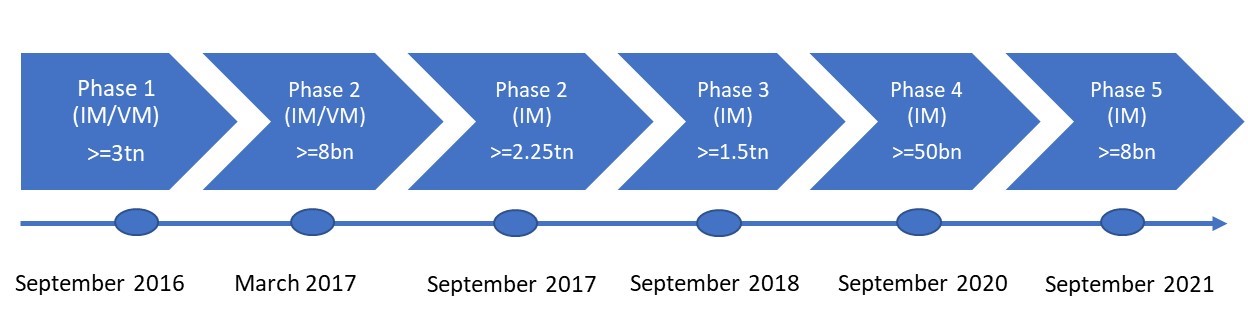
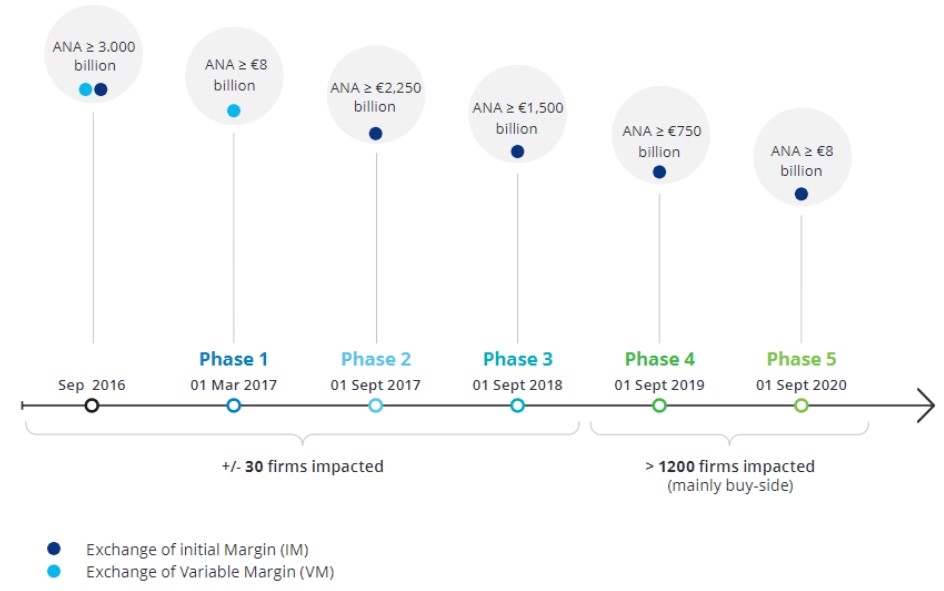
The initial implementation of Variation Margin (VM) requirements was implemented in 2017, while Initial Margin (IM) requirements continue to be phased in until 2021. The new IM rules that are to be put into effect in 2020 and 2021 affect primarily smaller financial organizations, including buy-side participants. Note that UMR has been phased in since September 2016 in the US and March 2017 for remaining market participants.
The initial Phases affected the interdealer market and required execution/negotiation of new CSAs, custodial arrangements, eligible collateral schedules and account control agreements with counterparties/custodians.
The upcoming Phases will affect smaller insurance/banking groups and asset managers, who naturally have less experience with the new rule requirements and likely, fewer resources to help with implementation.
Unlike variation margin, which is based on the market value of trades, initial margin is a risk-based calculation. VM also happens to be a mature concept for most firms; IM, though, is new for most institutional investors because it includes custodians in addition to the trading parties.
Key Dates
Adherence to UMR has been on a phased approach thus far; in 2018, market regulators postponed the last two Phases (4 and 5) by one year. The Phase 4 compliance date was originally September 2018 and was moved to September 2020. The Phase 5 compliance date moved from September 2020 to September 2021.
The phased thresholds for UMR means that, with each Phase, more and more In-Scope Counterparties will be affected and has been the source of some consternation among market participants.
In addition to the notional thresholds, IM is required to be posted between counterparties where there is a consolidated threshold of $50mn USD or $50mn EUR. Thus, if the IM threshold is less than $50mn, no IM needs to be exchanged.
Biggest Challenges
There are four main challenges for market participants when it comes to compliance with UMR:

Solutions
The IM rules consist of the following tasks that need to be completed by a market participant:
- Calculation of regulatory IM
- Collateral segregation and rehypothecation requirements
- Eligibility checks of collateral
- Settling of collateral (on T+1 basis)
- Threshold application (ie 50mn)
Because of this daunting list (many of which are operationally intensive), many participants have sought to outsource their adherence to the new guidelines.
But market solutions have been scarce; there are few all-in-one solutions; rather, a few vendors have capabilities in different facets of UMR
- There were originally two market solutions: Margin Xchange and ISDA create
- As of December 2018, neither had been released to market
- As of September 2019, Margin Xchange ended their product after regulators cut the industry workload by ~90%
- As of January 2019, ISDA create was launched and is free to the buyside
- As of September 2019, 50 firms were on ISDA create; more than 160 other firms are testing the platform ahead of Phases 4 and 5.

Here’s a list of what a ‘typical’ hedge fund needs to do:
- Assess which products are in-scope and calculate notional amounts
- See if the notional threshold is applicable or not
- See if the IM threshold is applicable or not
- Re-negotiate all Credit Support Annexes
- Calculate & Pledge IM and ensure it is held with Custodian Bank
- Ensure no rehypothecation of collateral
- Manage margin requirements: calculation, monitoring, segregation and reconciliation
Calculating IM
Calculation of IM is one of the more cumbersome requirements of the new rules. There are certain vendors who are licensed ISDA initial margin calculation service providers and can help with calculations.
Partial list of vendors who are licensed SIMM service providers
- AcadiaSoft Risk Services Suite
- Bloomberg
- Calypso
- Cassini Systems
- CME
- Clarus Financial
- Lombard Risk
- Murex
- OpenGamma
- Quantile Technologies
- TriOptima
Initial Margin (IM) has to be calculated via one of two methods : the grid method or the SIMM method.
Unfortunately, there is no clear preferred method in that both methods are operationally burdensome. Each method has its pros and cons, which will require each market participant to perform a cost benefit analysis.
Here we will list out some key points for each method.
Grid Methodology – A standardized schedule included by regulators
- Insufficient granularity of tenor buckets and product types
- The grid methodology has a lack of clear guidance from regulators and as a result, inconsistent interpretation. As a result, it hasn’t been widely adopted.
- The methodology seems simple, but results are difficult to compare between counterparties
SIMM Methodology
- Thus far, all entities that have implemented regulatory IM have used SIMM
- Takes into account offsetting risks
- Use of a standardized model allows simpler comparison of margin amounts and results in fewer disputes among participants
- Requires each counterparty to generate sensitivities for every trade – time consuming and requires huge amounts of market data
- The only regulator-approved IM model
Summary
If you are facing any of these issues in complying with the UMR rules, please reach out to FinServ. Throughout our 15 years of existence, we have proven that our deep industry knowledge combined with our project management and overall best practice methodologies can be an asset to your organization. To further continue the conversation or to discuss more of FinServ’s capabilities, please contact FinServ at info@finservconsulting.com or give us a call at (646) 603-3799.
About FinServ Consulting
FinServ Consulting is an independent experienced provider of business consulting, systems development, and integration services to alternative asset managers, global banks and their service providers. Founded in 2005, FinServ delivers customized world-class business and IT consulting services for the front, middle and back office, providing managers with optimal and first-class operating environments to support all investment styles and future asset growth. The FinServ team brings a wealth of experience from working with the largest and most complex asset management firms and global banks in the world.

Top 5 Most Exciting Features from Dreamforce 2019
As always, Dreamforce was an amazing event where Salesforce announces many exciting new features they are planning to roll out in their software over the next one to two releases. In the past few years, Lightning was the key focus area; however, this year, Salesforce made a strong pivot towards Einstein – their Artificial Intelligence (AI) platform. It is clear that integrating AI and Machine Learning into their platform has now become the main focus of where Salesforce is driving the majority of their new innovations. Therefore, it will be no surprise that many of the items on the list this year relate to Einstein features and functions.
#5 – Einstein Search
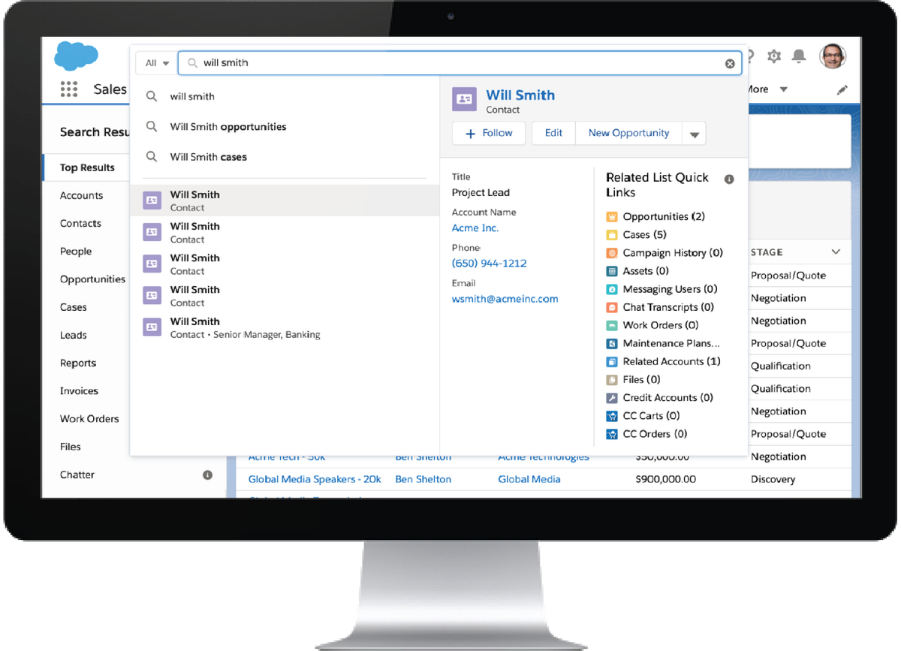
Per Salesforce, they are taking the Enterprise Search function in Salesforce to a new level by making it personal, natural, and actionable. One of the most exciting aspects of Einstein Search is that it will provide a personalized search result for each user. Einstein Search leverages both Machine Learning and Data Mining techniques to produce its’ results. Another exciting enhancement to Einstein Search is the ability to use Natural Language to enter a search. I saved the best for last and certainly the most exciting feature of Einstein Search will be the actionable toolbar. This toolbar will allow you to take action on your search results right from the search bar, which will result in a 50% reduction in clicks and page loads for your most frequently-used tasks. Reducing the number of clicks is far and away the number one requirement clients ask us for, so this will be a truly powerful new feature.
Note – This personalize results feature currently requires at least 100 active Sales Cloud licenses. Salesforce is working to remove this restriction.
#4 – Einstein Voice
This is a feature that was announced at last year’s Dreamforce with huge excitement and anticipation, but it was never released. We are happy to announce that this key feature is finally ready for beta usage in the upcoming release. Now you will be able to speak into your phone or many other compatible devices like Alexa or Google Dot to enter your info into Salesforce without having to type anything. Some key features that already exist include: Opportunity and Task Updates, Einstein Voice Skills (a new feature we will elaborate on in a future post) and the ability for Einstein to suggest follow ups tasks. You can also receive briefings from many smart devices by simply using natural language like: Give me my daily briefing, or What accounts are at risk? There is no doubt that allowing Sales reps who are on the road to update info and add leads without having to type this in will address the biggest issue people have had with getting data into Salesforce – the need to get key people to enter data. This feature promises to have the biggest impact on timeliness of information and the quality of information in Salesforce.

#3 – Pardot Lightning Email Builder
Salesforce announced a real game changer by leveraging their familiar builder canvas with components on the left, properties on the right, and drag and drop WYSIWG in the center panel so you can create dynamic and powerful emails right in Pardot. Key features include a totally responsive capability right out of the box where moving the email to any device will result in the email scaling perfectly. The Email Builder also includes key features like Hover and Link capability, as well as a Call to Action button and a Survey Provider. The release date for this feature is not set right now, but hopefully Pardot users will see this feature in a release in 2020.
#2 – Einstein Prediction Builder & Next Best Action
Einstein Prediction Builder used to be a paid Service and now it is free and included with Sales Cloud. In a nutshell, Prediction Builder will look at all your historical leads and assess which leads converted using Machine Learning. It will construct a model that will enable you to identify the leads your team creates that have the highest likelihood of closing, which will enable your team to maximize their efficiency in the sales process. Predictions are unique to each company you create; the domain expertise and prediction builder does the rest!
- How much is this deal likely worth?
- How long will it take for this deal to close?
Or
- Is this Lead Going to Convert?
Prediction Builder will support Einstein Next Best Action helping you to cross sell, upsell.
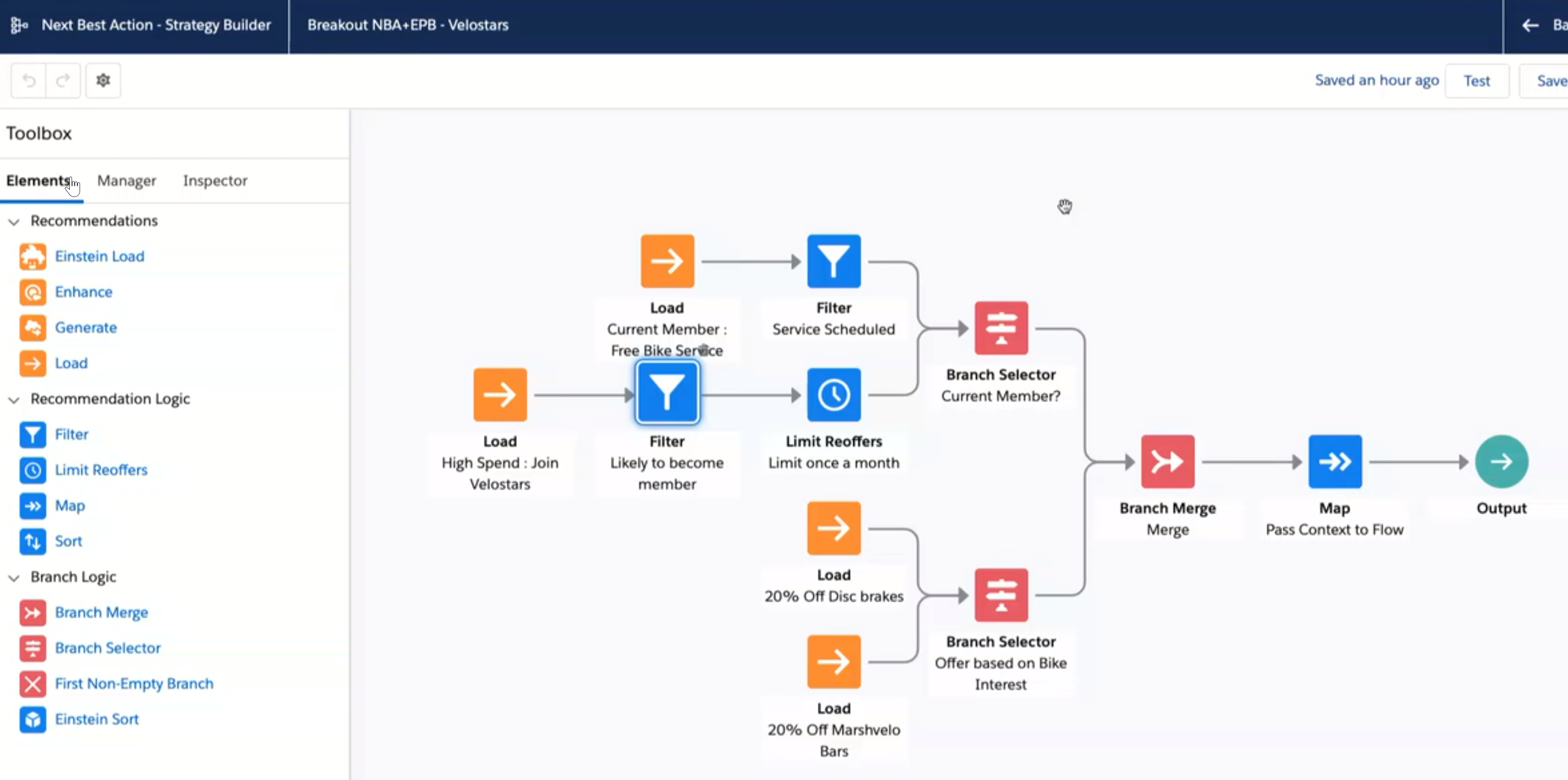
Next Best Action works on getting your insights to work together to create a unified decisioning layer in the form of a recommendation to a Salesperson’s desktop at the right moment and turn that into an action that results in a outcome (closed deal). Next Best Action also integrates to Salesforce Lightning Flow by allowing a customer to link to an automated workflow.
#1 – MyTrailhead
Salesforce is now offering companies the ability to leverage their world class learning platform to provide bespoke training for any company. Imagine a simple and user-friendly interface that will fast-track compliance and other core company-required training because of its’ usability. . With Badges used to incent employees and interactive videos and quizzes to confirm knowledge, the Trailhead platform provides a top-notch environment to ensure key financial services requirements are fully covered by all employees while making it fun and easy to complete.
Uses include:
- Supercharging the Employee Onboarding Process including critical Compliance Training
- Reinforcing the Company Culture

Conclusion
These features, available now or in Beta and some that will be available in 2020, are items your organizations should seriously consider for your Salesforce roadmap in 2020. Each of these features will add great value to key areas like data integrity, compliance, user adoption and user friendliness of your system. If you would like help with planning or implementing these solutions, or just get more info or a demo on these features, FinServ would love to help. You can reach us at info@finservconsulting.com or give us a call (646) 603-3799.
About FinServ Consulting
FinServ Consulting is an independent experienced provider of business consulting, systems development, and integration services to alternative asset managers, global banks and their service providers. Founded in 2005, FinServ delivers customized world-class business and IT consulting services for the front, middle and back office, providing managers with optimal and first-class operating environments to support all investment styles and future asset growth. The FinServ team brings a wealth of experience from working with the largest and most complex asset management firms and global banks in the world.
Mountaineering Tips for a Black Mountain Implementation
Hiking up any formidable summit requires experience, expert guidance, and determination to succeed. Navigating a Black Mountain implementation is no different. It can be a challenging and complex experience for asset managers that are not prepared to embark on the journey.
What is Black Mountain?
Black Mountain is a best-in-class, industry-standard provider of highly configurable front- and middle-office software solutions for investment managers. Part of newly formed Allvue Systems, owned by Vista Equity Partners, Black Mountain is an innovative suite of solutions for portfolio management, trading, credit research, and direct lending. Investment firms utilize Black Mountain to streamline critical business processes that are at the heart of all front- and middle- office activities.
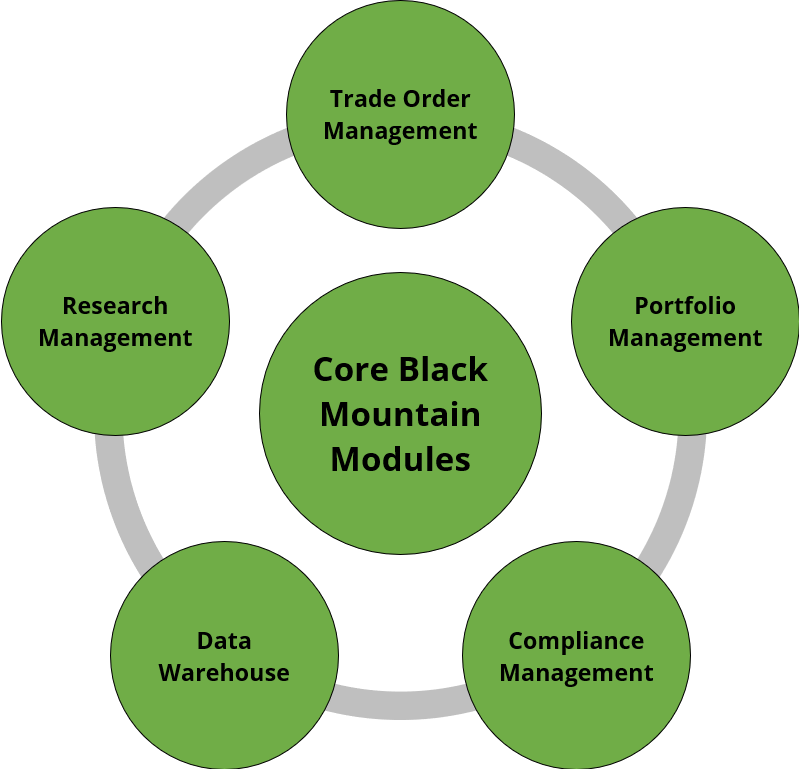
- Research Management: Integrates deal pipeline, analyst commentary, and ongoing coverage with trading activity and portfolio exposures. Includes the ability to push Excel-based financial templates into Black Mountain for aggregate research analytics.
- Trade Order Management: Streamlines order entry with broad asset class coverage including loans, bonds, municipal securities, equity, CDS, ABS, MBS, futures/options, swaps, repos, FX, and real estate. Easily accommodates data input controls, alerts, and custom portfolio allocation methodologies.
- Portfolio Management: Dynamic dashboards, charts, and analytics are tied to trading activity for all supported asset classes. Additionally, 3rd party data sets can be incorporated into the system to provide robust reporting capabilities to meet changing company, market, and regulatory needs.
- Compliance Management: Supports pre- and post-trade portfolio compliance via a powerful and robust compliance calculation engine.
- Data Warehouse: Facilitates historical data capture and reporting requirements. Enterprise data management tools can be leveraged in the system to define data priority, conflict resolution, and alert users using rule-based data gap checks.
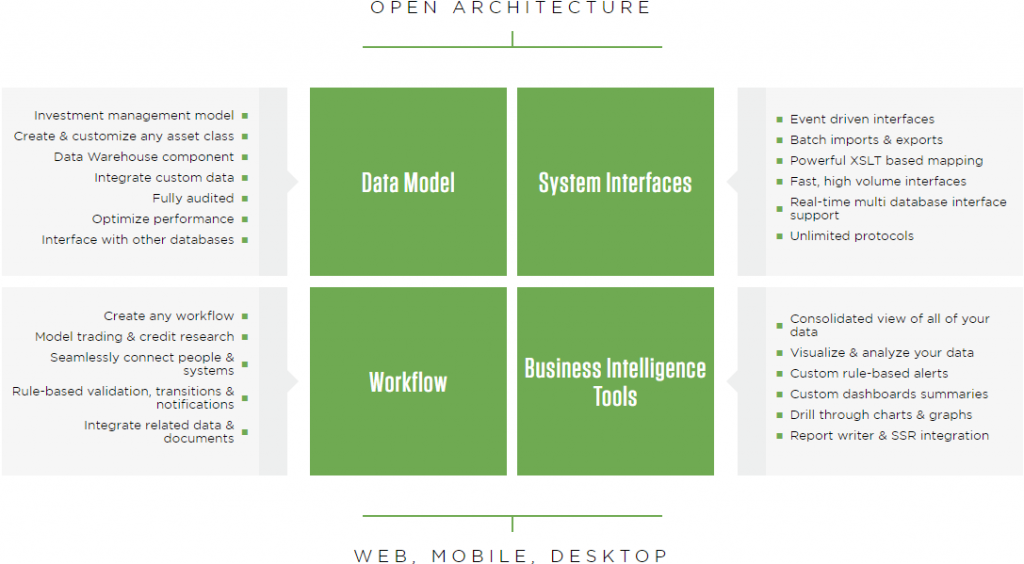
Source: Black Mountain Systems
What to Know Before Getting Started with a New Black Mountain Implementation
- Get Help Early: Don’t assume that you only need help after a Black Mountain contract is signed and the implementation officially begins. There is valuable preparation work that can and should begin well ahead of any Black Mountain implementation. The clearer current and desired future state are defined (and documented) before involving the Allvue implementation team will only improve the quality of overall system design, reduce the risk of misinterpretation, and will save time/budget in the long-run.
- Don’t Rush the Scoping Process: In a similar theme, resist the urge to “just get the implementation started”. Black Mountain implementations start with a handful of scoping sessions/workshops to formally outline the core project scope, assumptions, and risks in the form of a Scope Document. While additional requirements gathering will take place in an agile fashion throughout the project, the initial Scope Document will govern your initial project budget. It is easy to misinterpret what you are getting if you are not familiar with Black Mountain and it is important to manage expectations on all sides.
- Out-of-the-Box Solutions Still Need Initial Configuration: Every Black Mountain client is different. Even though Black Mountain has a treasure trove of standard, out-of-the-box features and functions, much of it still requires configuration before being usable in a production environment.
- You Need to Understand Your Data: Garbage in really is garbage out. Not only does data need to be clean before being consumed by Black Mountain, but you need to be proactive about how to resolve data conflicts. This includes understanding data origination, priority, and downstream reporting dependencies. If the same field can come from multiple sources, which source should be used and in what scenarios? Do you need an additional Security Master solution on top of your Black Mountain implementation?
- The More You Know, the More You Will Want: As your team gets more familiar with the power of the Black Mountain platform, get ready for new ideas and user requests. Setting aside a reasonable budget to handle new requests will help you address these requests and improve user satisfaction/adoption.
- Aim to Leverage 3rd Party BI Tools for Reporting: Consider leveraging 3RD party BI tools like Microsoft Power BI or Tableau via Black Mountain APIs in order to self-service a larger portion of your dashboard/reporting needs via direct systematic access to your data stored in Black Mountain.

How FinServ Can Help
- Ability to Bridge the Gap: The FinServ team is made up of talented consultants that possess both a deep level of industry knowledge and technical expertise. Coupled with the team’s Black Mountain platform knowledge, FinServ is able to help clients bridge the knowledge gap with the Allvue implementation team to streamline the implementation process by calling out potential design limitations and clearly articulating complex requirements using cross-functional workflows, UI/UX wireframes, and by creating detailed end-user documentation.
- Project/Program Management: FinServ provides best-in-class project management staff that are experts in managing scope change requests, issue logs, preparing executive level presentations, and detailed weekly status reports. These activities together ensure that all levels of the client organization are kept up-to-date on the most critical aspects of the project progress and that issues are escalated proactively.
- Business Analysis, Data Analysis, and Documentation: FinServ skilled business analysts can support clients by providing hands-on project delivery activities like documenting requirements, performing data mapping, testing, and creating formal system documentation that otherwise would take you away from your day job.
- Full-time, Onsite Consultants with White Glove Service: FinServ can provide full-time, onsite consultants to support a Black Mountain implementation. This level of support ensures that any issues that arise are immediately reviewed and often resolved immediately. For any issues that cannot be resolved immediately, detailed resolution requirements are documented and provided to the vendor for immediate remediation, testing, and verification back out to the user.
The Bottom Line
Black Mountain is a robust, powerful platform for investment managers, but getting started with a Black Mountain implementation can be a daunting task if you don’t prepare ahead and don’t have the right adviser supporting you on your journey. FinServ Consulting’s Black Mountain expertise and unparalleled track record of service for asset management clients makes us the right partner for any Black Mountain project.
To learn more about FinServ Consulting’s services, please contact us at info@finservconsulting.com or (646) 603-3799.
About FinServ Consulting
FinServ Consulting is an independent experienced provider of business consulting, systems development, and integration services to alternative asset managers, global banks and their service providers. Founded in 2005, FinServ delivers customized world-class business and IT consulting services for the front, middle and back office, providing managers with optimal and first-class operating environments to support all investment styles and future asset growth. The FinServ team brings a wealth of experience from working with the largest and most complex asset management firms and global banks in the world.
Implementing Workday – What Your IT Staff Can Expect
If you are considering implementing Workday for your Human Capital Management (HCM) and / or Financial system needs, then you are likely aware that Workday is a Software as a Service (SaaS) application – centrally hosted and consumed over the Internet as a Service. The SaaS model will save your organization time and money on the maintenance tasks typically associated with an on-premise software installation. What it won’t do is absolve your IT staff from all Workday responsibilities, rather your team’s responsibilities will shift. Depending on your organizational structure, this role can stay solely within IT or it can be split between IT and the Business.
Let’s review the traditional on-premise software model and how your staff supported it.
| On-Premise Software Support Responsibilities |
|
|
|
|
|
|
|
|
|
|
With Workday, your IT Staff largely pivots away from the infrastructure maintenance to an application maintenance and integrations focus. Your staff would support Workday’s “Delivered Value” as defined in the Workday Technology Illustration below.

Let’s examine each “Delivered Value” item to determine how they translate into responsibilities for you and your staff.
Web Familiar Experience
Workday’s main user interface is through the Web Browser and will be how your users primarily interact with Workday (there is also an App).
Enabling your users to access Workday will be dependent on your staff and this can include the following application Maintenance and Support tasks.
- Adding and configuring New Users in Workday including Single Sign-On (SSO) set up
- Disabling Terminated Users
- Setting login and password expiration settings
- Monitoring New Releases and reviewing their corresponding System Release Notes
- Using Business Analysis to plan and manage projects for Enhancements and Additional Component Activation
- Keeping abreast of major functionality changes that will benefit your firm such as Workday Prism Analytics
- Configuring and Testing System Changes
- Troubleshooting User Issues and Managing the Issues to Resolution
- Administering your Workday environments (tenants) – Production and Staging to manage system refreshes and upgrades
Enterprise Reporting
Workday will become the Golden Source for your firm’s Human Resources and Financial data. Naturally, your users will want to take advantage of this and will want a comprehensive set of reports. Building these reports will require your staff to understand how Workday stores the data and how to extract the data using specific report types.
Furthermore, you will also need to think beyond Workday to consider how HR and Financials data in Workday can augment and complement the data in other areas of your firm. At many of our clients, the strategic vision in consolidating all of the firm’s data involves another tool, usually a Data Warehouse.
- Building Matrix Reports
- Building Advanced Reports
- Building Composite Reports
- Understanding the available set of pre-configured reports
- Planning how Workday data can be used throughout your firm
Integration On-Demand
Central to Workday’s functionality is the ability to communicate your data with both internal and external parties. Internally, you may want to have Workday interact with your internal CRM system such as Salesforce (typically for deal pipeline or other customer management). Externally, you will want to have Workday interact with your various Vendors for Procurement Punch-Outs, Banking Transactions, Benefits and Payroll. This data flow is done via Integrations / API Calls that were initially set up during the initial Workday deployment by the Workday Integrators.
Maintaining the Integrations, API Calls and related File Transfer Infrastructure will fall on your staff and the responsibilities include the following:
- Mapping out both internal applications and external vendors that will interact with Workday
- Monitoring Integration Runs and Troubleshooting Errors
- Collaborating with Vendor Contacts to determine the root cause and resolve
- Building custom Integrations in Workday Studio (if standard integrations do not meet requirements)
- Configuring and maintaining a File Transfer Server (if necessary) with secure file protocols such as SFTP, SSL, SSH, etc.
- Supporting file encryption with keys such as PGP keys
- Configuring the Firewall to white list Vendor IPs to allow the Vendor to connect to your File Transfer Server
Configurable Business Processes
Business Processes allow you to define and create your firm’s workflow in Workday. For example, to hire a new employee, each firm will have their own steps to initiate the hire process, enter data, run background checks, obtain approvals, etc. This process is taken from your firm and then re-created in Workday.
Your staff will need to develop their Business Process skills to support the business in the following manner.
- Investigating and Resolving Business Process Issues
- Creating and / or modifying Business Processes
- Tracking approvals given for Business Process changes through the Request Framework or other internal tool
- Reviewing and Analyzing the Business Process for risks due to Key Man Dependency, Separation of Duties, Improper Access Granted, etc.
Summary
Implementing Workday will require your IT staff to be fully committed and involved in the implementation from the beginning. This is critical for a successful implementation and a seamless operational support transition. Your IT staff will not be as focused on Physical Infrastructure but rather on Workday and the systems / components related to Workday. IT’s role is critical for segregation of responsibilities and allows your firm to successfully address audit points and regulatory concerns. This post is designed to guide and instruct you on the changes to come to you and your staff. FinServ has advised multiple clients on supporting their Workday implementation, augmenting their support staff and improving upon existing processes. FinServ is an experienced Workday integrator with the deep industry expertise needed to configure Workday optimally for your firm. For help in implementing or enhancing Workday, contact FinServ at info@finservconsulting.com or give us a call at (646) 603-3799.
About FinServ Consulting
FinServ Consulting is an independent experienced provider of business consulting, systems development, and integration services to alternative asset managers, global banks and their service providers. Founded in 2005, FinServ delivers customized world-class business and IT consulting services for the front, middle and back office, providing managers with optimal and first-class operating environments to support all investment styles and future asset growth. The FinServ team brings a wealth of experience from working with the largest and most complex asset management firms and global banks in the world.
What Keeps a CTO Up at Night and How a Managed Service Provider Can Help
Hedge Fund Chief Technology Officers (CTO) face a litany of responsibilities ranging from:
- Maintaining the technical infrastructure necessary to run their firms
- Overseeing regulatory compliance in the technology stack
- Guarding the firm’s non-public data and systems
- Managing critical investment and trading systems
- Shepherding the firm’s adoption of future technology paradigms
To deal with each challenge effectively and comprehensively, CTOs need to narrow their focus to the key issues that involve protecting the firm and their investors and ideally giving the firm a competitive advantage.
Infrastructure / Support tasks can in some cases be removed as a distraction and partially or wholly outsourced to a Managed Service Provider (MSP), a company that remotely manages a customer’s IT infrastructure, applications and / or systems. Often, leveraging the right MSP will allow a fund to redirect their investments in physical infrastructure and onsite support of that infrastructure to other more mission critical projects. With the right MSP partner, a fund can scale quicker and create a robust infrastructure, supporting enhanced performance and productivity, while leveraging the deep and specialized expertise of the MSP. This is especially true with the popularity of Azure and AWS, where the right MSP has deep expertise in leveraging these environments and locking them down securely, an expertise that many funds do not want to hire for internally.
The decision to use an MSP may seem straightforward. But, in order to use an MSP successfully, several factors must be thought through before even engaging with the MSP. (Note that, while we assume you are working with MSPs for the first time, even if you currently have an MSP and are looking to replace them, our subsequent advice is still relevant!) When FinServ performs a vendor selection for our clients in the MSP arena, we focus on the following key questions and on documenting the existing state of key items to facilitate the transition:
| Key Activities |
|
|
|
|
|
|
MSP Goals
In order to successfully choose and onboard an MSP, it is critical to understand and document the main goals you are ultimately trying to accomplish and how. Consider the following:
| MSP Goals |
|
|
|
|
|
|
|
|
|
|
|
|
|
|
|
|
|
|
IT Current State
The MSP’s responsibility is to take on the tasks that your current IT staff is doing. How do you communicate that clearly and succinctly to the MSP so that both parties have a common understanding of what tasks are in scope?
The answer lies in having a full understanding of what your existing IT footprint is and what your current IT staff does. Rationalizing their current roles and what the target operating model will be is crucial to a successful transition.
To effectively outsource tasks that were handled internally to an external party, it is critical to understand all tasks that your staff does, system dependencies and external dependencies. Once you have a holistic picture, you can then go through the exercise of segregating tasks that will be outsourced and those that will remain in-house. With a clear definition of the tasks that you expect the Managed Service Provider to take on, the expected roles and responsibilities will start to become evident.
To achieve this goal, FinServ developed a “Functions of a Hedge Fund” map which allows us to review all the functions you have and then efficiently highlight which functions will be targeted for partial or full outsourcing. This becomes a key document to share with the vendors during the selection process.
Questions to ask yourself include:
- Do you have a complete and well documented picture of your firm’s IT hardware and applications?
- Do you have a comprehensive and well documented view of what the IT staff does? Ask yourself, your managers and your staff. This operational assessment exercise might surface some unexpected discrepancies in your understanding of their tasks to what they actually are
- Which tasks will be outsourced?
- Does the MSP have the resourcing / skill-set to do those tasks effectively?
- How will the MSP be enabled to do those tasks effectively?
The FinServ team are experts in comprehensive current state documentation. We can quickly document these current state items to ensure the selection process is based upon your firm’s unique footprint and requirements.
Choose and Assess the MSP
As the technology thought leader, you should determine and agree on how you will choose the MSP. Choosing an MSP is no small task and to give yourself the best chance at success, this needs to be carefully considered. Having an experienced consultant like FinServ with specific knowledge of the MSP marketplace and industry trends can increase your firm’s chances for success.
| Choose and Assess |
|
|
|
|
|
|
Onboarding and Managing the MSP Relationship
Equally as important as selecting the right MSP for your firm, ensure you can properly onboard and manage the MSP. In most cases, we have seen that clients do not have the dedicated resources to see this part of the MSP process through. Should that be the case, it is critical to get an experienced consultant like FinServ who can provide dedicated expert resources to lead you through the process.
Once the MSP is onboarded, they will need to be managed – you will need to have measures of success in place to measure the MSP’s performance. As part of the selection process, meeting with each MSP candidate to review their understanding of how you will evaluate their performance is critical. Consider items such as:
| Onboarding and Managing the MSP |
|
|
|
|
|
|
|
|
|
|
|
|
|
|
|
|
Summary
If any of these themes resonate with you and your organization, please reach out to FinServ. FinServ has advised and managed multiple Funds through selecting and onboarding a Managed Service Provider.
By leveraging our methodologies and industry best practice tools we can expedite your selection and ensure a successful onboarding process saving both time and money and ensuring this complex and critical process meets the goals you set for it at the start.
If you already have an MSP, but they are not providing the services that you require, the same thought processes and best practices are still relevant when replacing your existing MSP.
Throughout our 15 years of existence, we have proven that our deep industry knowledge combined with our project management and overall best practice methodologies can be an asset to your organization. To further continue the conversation or to discuss more of FinServ’s capabilities, please contact FinServ at info@finservconsulting.com or give us a call at (646) 603-3799.
About FinServ Consulting
FinServ Consulting is an independent experienced provider of business consulting, systems development, and integration services to alternative asset managers, global banks and their service providers. Founded in 2005, FinServ delivers customized world-class business and IT consulting services for the front, middle and back office, providing managers with optimal and first-class operating environments to support all investment styles and future asset growth. The FinServ team brings a wealth of experience from working with the largest and most complex asset management firms and global banks in the world.
Shadow Accounting – Benefits, Issues, and Realities
Overview
Many investment funds outsource their back office and fund administration services to third-party administrators. Fund administration services typically include calculation of net asset value (NAV), daily, weekly or monthly P&L reporting, fee calculations and other activities that constitute being the official books and records. The reasons for using third-party administrators are well documented and typically include investors’ preference for an independent firm to oversee a fund’s financials. In addition, third-party administrators provide the ability to scale and often provide a sliding pricing model that goes up when a firm does well and down when a firm does not. Lastly, firms can take advantage of admin technology without the need for supporting this infrastructure in-house.
Shadow accounting is the process of maintaining an additional set of financial books for the purposes of comparison with the third-party administrator.
Reasons for shadowing your administrator
| Speed of reporting | Maintaining their own set of books affords funds the flexibility to determine their own schedule. While third-party administrators are held to service level agreements, they often do not cover ad-hoc reporting requirements and if they do, the agreements usually do not offer turn around times that are typically expected by senior management. Having your own systems and ability to report allows funds the opportunity for off-cycle reporting and if applicable, real-time analytics. |
| Reconciliation with the Fund Administrator | As mentioned previously, the responsibilities of an outsourced administrator can be broad. They’re often responsible for producing the NAV which has a direct correlation to the calculation of fees. Since there are many factors that go into these calculations, funds often like to have a separate process for producing these calculations to compare with their admin. When the numbers match, all is well. When the numbers are different, an investigative process will be conducted to determine the correct values. |
| Aggregation of multiple administrators | When funds have a multi-fund administrator model, it is sometimes difficult to get a complete picture across the fund family. Maintaining a shadow set of books allows funds to report across individual strategies and produce a holistic view of their performance. |
| Connection to risk and reporting systems | As part of the overall fund technology infrastructure, financial data is often sent downstream to allow for risk reporting, budgeting and forecasting, P&L data and other analytics. While this may not be the primary reason for shadow accounting, funds can become dependent on this data and having this data in-house may provide better data and allow for better reporting. |
| Lack of comfort/trust | Certain funds feel like they must outsource their back office and middle office operations since investors require it. When going through this process, if the admin fails to garner the trust of the in-house fund accountants, the fund may feel uneasy about eliminating their internal calculations and controls. In this era of increased regulatory scrutiny, it is more important than ever to have accurate information as incorrect filings can lead to fines and penalties. |
| Valuation accuracy | Producing a second set of books gives the fund an opportunity to apply their valuation and pricing strategy to their portfolio. In theory, this should match the admin’s valuation policy, but many times differences surface due to alternative market data sources. In the end, shadowing the portfolio leads to informed decisions when valuing investments. |
| Investors and allocators want it | There are investors or allocators that strongly prefer when a fund shadows their admin. It provides another level of control and has a positive impact on the due diligence reports conducted by potential investors. With the number of firms competing for investors, providing evidence of increased controls through shadow accounting has become a requirement. |
Full Shadow Accounting vs. ‘NAV lite’
NAV lite (or NAV light) is the process of taking in key inputs from the admin or other external sources and performing a check on the NAV calculation. In addition, it is common for the internal fund team to perform fee calculations as both an input and output to the NAV. Funds choose to do this to gain a level of comfort and provide senior management with confidence that the calculations are correct. The advantages of this approach are staffing requirements are reduced, and a full-service fund accounting system is not needed. Having confidence in the calculations is often enough to ensure the accuracy of the administrators. Some would argue however, there is no substitute for starting from the trade and entering all the debits and credits needed to calculate a NAV and a full set of financials in order to ensure accuracy. Shadowing only the NAV involves dependencies from the data being supplied by the admin and therefore comes with risks that mistakes could be made and the NAV can still be incorrect.
The Verdict
A recent survey indicated that over 80% of all investment managers perform some level of shadow accounting. It is rare for an investment firm to have the ability to raise capital without additional scrutiny that has become the norm in the industry. Investors and allocators have a large population of investment managers to choose from and have applied increased scrutiny as part of their due diligence. Most allocators have made it clear that shadow accounting is a requirement or at least desired. In addition, the data investors, auditors, and regulators are asking for is easier and quicker to produce when internal systems can be used. Therefore, funds have overwhelmingly made the choice to fully shadow or partially shadow their admins.
The Realities of Shadow Accounting
The realities of this decision are the increased investment from a cost and resource perspective, in a fund’s infrastructure. Funds are increasingly choosing order management systems and performance management applications that either has an accounting engine or can produce reports that can be used to produce a NAV. Choosing a system or systems to perform this function can be difficult and proper resources should be dedicated towards the selection and implementation. Similarly, choosing an outsourced shadow accounting provider is a critical decision that should be made after proper vetting. All funds are unique and therefore making decisions based on what worked for other funds typically leads to failed implementations. Choosing a system or vendor is a long term decision that is difficult to undo and requires attention to detail and diligence to get it done properly.
FinServ Consulting has been providing advisory, technology and business solutions to investment firms for over 15 years.
For more information on how we can help or guide your strategic direction, please contact us at info@finservconsulting.com or 646-603-3799.
About FinServ Consulting
FinServ Consulting is an independent experienced provider of business consulting, systems development, and integration services to alternative asset managers, global banks and their service providers. Founded in 2005, FinServ delivers customized world-class business and IT consulting services for the front, middle and back office, providing managers with optimal and first-class operating environments to support all investment styles and future asset growth. The FinServ team brings a wealth of experience from working with the largest and most complex asset management firms and global banks in the world.
Salesforce myTrailhead is Your New Customizable Learning Platform to Educate Your Workforce
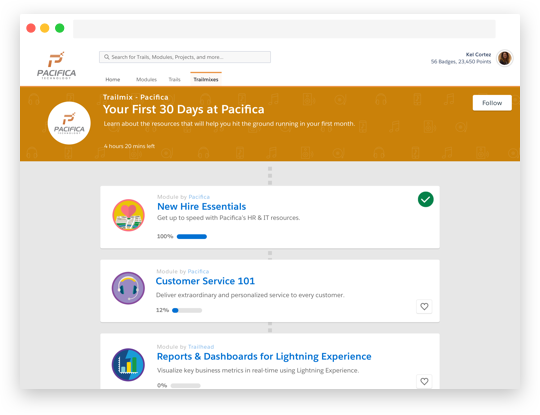
Salesforce recently announced the rollout of myTrailhead as a standalone add-on product for existing Salesforce customers. Salesforce Trailhead was originally designed as a self-learning and education tool for Salesforce users allowing anyone (customer or not) to start learning, earn badges, and work towards Salesforce certifications. Over the years, Salesforce began adding non-Salesforce specific knowledge on to Trailhead including topics like HR diversity/inclusion and EU data privacy laws. Salesforce myTrailhead takes that idea further than ever by extending the highly successful Trailhead learning management platform by allowing customers to add their own firm-specific content.
myTrailhead allows customers to create, manage, and deploy their own tailored, firm-specific education on top of the existing Trailhead platform and knowledge base. While the core focus of Salesforce Trailhead was traditionally focused around educating core Salesforce users (i.e. sales professionals, system administrators, and IT support staff), Salesforce myTrailhead is a general-purpose learning experience tool that can serve several multi-purpose roles for any asset management firm.
Why is Salesforce myTrailhead Such an Important Product Release?
“Business leaders recognize that investing in their people and building a deep culture of learning is a key strategy to moving their company forward.” – Sarah Franklin, EVP of Developer Relations and GM of Trailhead

Employee well-being is now an ever-growing focus of all firms drawing huge amounts of time, attention, and capital across HR. Technology giants lure top prospects with benefits such as onsite gym/laundry, stockpiled snacks in the pantry, and paid meals. The asset management industry is no different with all firms looking for the best ways to spend on employee morale to either differentiate themselves or at least to seem competitive with their peers. Salesforce believes that cultivating a culture of learning is one of the best bang-for-your-buck ways to attract, retain, and engage your workforce, while helping employees gain new, valuable skills along the way.
A study by Josh Bersin discovered that employees who spent five or more hours a week learning achieved the following benefits compared fellow employees that spent an hour or less in similar activities:
-
74% more likely to know where they want to go in their career
-
48% more likely to have found purpose on their work
-
39% more likely to feel productive and successful
-
21% more likely to be happy at work
-
47% less likely to be stressed at work
Create a Culture of Continuous Learning at Your Company Today
Creating a learning management experience for your firm can seem daunting if you are starting from scratch, but there are a ton of areas that should be low-hanging fruit for any asset management firm:
- New Employee Onboarding and Firm Intro Education
- Overview of Key Departments and Product Areas
- What You Need to Know – New Strategy Launch
- Compliance Training and Attestations
These are just some ideas to get some creative juices flowing, but truly the possibilities are endless.
What Makes the Salesforce Trailhead Platform Great?
FinServ Consulting is a Salesforce Partner and we have long recognized Salesforce Trailhead as the platinum standard for vendor-specific learning and education. Salesforce Trailhead launched during Dreamforce 2014 and it was immediately clear that Salesforce created something special: an engaging, non-threatening ecosystem for users of all levels to self-teach and learn valuable new skills.

Key Highlights
- Self-Paced Learning: Trailhead leverages an interactive learning style made popular by educational websites such as Coursera and Khan Academy. The goal is to provide users learning Salesforce with easy access to the information and training that they need at their own pace and schedule. With Salesforce Trailhead, you can learn exactly what you need when you need it by choosing the appropriate set of trails.
- Gamification: Points and badges are awarded to users on successful completion of units and modules. The points and badges are displayed on each user’s profile, so you can get recognition for your expertise. After achieving certain point and badge totals, users will “level up” to a higher rank. Users start off on the trail as a “Scout” and can progress level-by-level to higher ranks like “Hiker”, “Mountaineer”, and ultimately “Ranger”.
- Learning Paths: Content is arranged in a hierarchy with three main levels: trails, modules, and units. Material is presented in an ordered sequence, so customers have a predefined learning path to follow without having to spend time on deciding what to read and in what order.
- Modular Learning and Engaging Content: Each tutorial consists of short units the can be reviewed quickly in 10-15 minutes each. The content is designed to be simple, self-contained, and high impact to maximize the value of the time spent in Trailhead.
- Interactive Assessments: At the end of each unit, users will be challenged to verify what that they learned the material, either by answering multiple-choice questions or performing specific tasks in sandbox or playground environment. Feedback is immediate and users can tell how well they mastered any concepts based on how the system scores their responses/activities.

The Bottom Line
Salesforce myTrailhead is a learning experience platform that empowers companies to reinvent how they are approaching learning and enablement. With myTrailhead, you can leverage and extend the power of the base Trailhead platform by incorporating your company’s specific customizations around logos, branding, and specific content. With a skilled hand, users can create and publish engaging, personalized, bite-size content to empower learners to develop new skills, hone existing ones, and showcase their knowledge with badges and points.
Getting started with a learning experience tool like Salesforce myTrailhead can seem daunting, but FinServ Consulting can help you seamlessly plan for and implement these technologies to suit your unique firm needs. FinServ Consulting is a Salesforce Consulting Partner with deep expertise in asset management, systems integration, and strategic consulting. Our guidance ensures that our clients receive the best tailored recommendations for all their Salesforce needs.
To learn more about FinServ Consulting’s services, please contact us at info@finservconsulting.com or (646) 603-3799.
About FinServ Consulting
FinServ Consulting is an independent experienced provider of business consulting, systems development, and integration services to alternative asset managers, global banks and their service providers. Founded in 2005, FinServ delivers customized world-class business and IT consulting services for the front, middle and back office, providing managers with optimal and first-class operating environments to support all investment styles and future asset growth. The FinServ team brings a wealth of experience from working with the largest and most complex asset management firms and global banks in the world.
The Importance of Virtual Data Rooms for Private Equity Firms
Over the past few years, artificial intelligence (“AI”) has raised fears that robots will replace human labor. However, for those in the private equity (“PE”) industry, artificial intelligence can give firms a competitive edge in the alternative investment space. AI technology can improve more process-driven functions of PE firms such as: increasing the power to collect, process and distribute information with speed and accuracy to the appropriate parties.
PE firms are having issues with finding the right investment target with the appropriate valuations. Developing a solution to managing the deal-making process will help a PE firm surpass their competition. One solution is utilizing a virtual data room (“VDR”).
What is a Virtual Data Room?
A virtual data room is an online repository of information that is used for storing and distributing documents. It allows private equity firms to stay on top of their management responsibilities. Virtual data rooms are used to aid the due diligence process during an M&A transaction, loan syndication, or private equity and venture capital transaction. Additionally, virtual data rooms can facilitate the deal process from beginning to end (i.e. Sourcing Deals, Managing/Closing Transactions, Monitoring Investments) Some key areas in which VDRs are most useful for private equity firms are in the consistency and responsiveness of information. For consistency, documents can be updated regularly, providing the vendor full control over data, identifying investment targets and generating valid valuations. For responsiveness, documents are easily accessible allowing assets to be brought or sold whenever required.
How are Virtual Data Rooms Utilized?
The end goal of a private equity firm is to sell an asset for a profit. In order to do so, the firm must create a life cycle virtual data room that can aid a company throughout period ownership, purchase, through management and sell. Authorized users are linked digitally through virtual data rooms (i.e. internal parties and external stakeholders) in a secure environment with live access to the appropriate documentation. The virtual data room will ensure that all documentation linked to specific transactions are accessible and equip with the latest updates for the authorized users. In other words, data is securely stored on a server platform and is always accessible to internal/external users based on their permission levels. A virtual data room provides asset managers full control and ability to stay up-to-date on the latest market conditions.
Importance of Accurate Documentation for Private Equity Firms
Accurate documentation is essential for private equity firms. During the deal process, inaccurate or incomplete documents can be a major pain point for private equity firms. The value of an asset must be accurately assessed on all required documentation must be organized in a standardized manner, providing access to important information. Standardize and sustainable data created through virtual data rooms can create long-term value for private equity firms.
How Private Equity Firms Can Improve Their Value with Virtual Data Rooms?
In order to be steps ahead of the competition and high valuations, private equity firms must utilize document management systems. A virtual data room will ensure that the stages of an asset’s life cycle (i.e. buying, holding, and selling) is running much smoother. Virtual data rooms can help private firms make better investment decisions/deals, improve operational efficiency and enhance the transparency amongst key stakeholders in the firm.
The Top Virtual Data Room Providers of 2019
According to DataRooms.org, here are some of the best Virtual Data Room providers of 2019:
- iDeals – founded in 2004, the company became a virtual data room provider of choice for top-tier financial institutions, investment banks, hedge funds, real estate, and legal global corporations. The platform provides security and collaboration tools which are essential for any global business operating in any industry. Some of the features include behavior tracking, data management, and file organizing tools which are useful during the due diligence phase of the deal.
- Intralinks Dealspace – established in 1996, their clients are mostly large corporations (i.e. companies listed on the Fortune 100) and focus on large scale deals. On average, the price for Intralinks service is higher than most virtual data rooms. In addition, to secure data storage and exchange, it ensures smooth collaboration inside and outside an enterprise: the tools offered to simplify with external parties. The deal-making is the main focus of Intralinks, and it does its best to guarantee support on each stage of the project execution. Especially helpful throughout the due diligence process for large enterprises.
- Merrill Datasite – main focus is on dealing with global financial institutions and big names in the business. Many well-known banks and Wall Street players are using DataSite. Merrill Datasite caters primarily for owners of large deals who are willing to pay for specific features such as multi-layered security, easy data upload, granular user permissions, and 24/7 customer support. One of the main tasks is to ensure smooth and productive internal and external interaction and teamwork.
- Brainloop – main focus is to aid throughout the deal-making collaborations. Brainloops provides diverse software that simplifies and facilitates communication between the project participants and guarantee safe information exchange. It can be used during M&A deals, Biotech licensing, as a solution for financial services. Brainloop comes equipped with a platform called Secure Dataroom. Secure Dataroom is convenient and helpful for all deal-makers who seek for a safe environment for information exchange.
- Firmex – a new player in the virtual data room market, founded in 2006. Some of their clients include Deloitte, PWC, E&Y, Deutsche Bank, and many representatives of investment banks, legal firms, energy, mining, pharmaceutical sectors. Firmex is most convenient for merger and acquisition transactions as it is equipped with multiple instruments that facilitate communication, speed up diligence, and simplify every aspect of collaboration.
- Box – known by its strict user access control, automatic indexing, industrial-grade file management tools. Box has a user-friendly interface that attracts many users and a large corporation. Furthermore, the platform offers a wide range of instruments and provides clients with multiple features that make internal communication and collaboration with external partners smoother and more convenient.
To learn more about FinServ Consulting’s services, please contact us at info@www.finservconsulting.com or (646) 603-3799.
About FinServ Consulting
FinServ Consulting is an independent experienced provider of business consulting, systems development, and integration services to alternative asset managers, global banks and their service providers. Founded in 2005, FinServ delivers customized world-class business and IT consulting services for the front, middle and back office, providing managers with optimal and first-class operating environments to support all investment styles and future asset growth. The FinServ team brings a wealth of experience from working with the largest and most complex asset management firms and global banks in the world.